I love to read, and I love to know what everyone else is reading and what they’re thinking about it all. Nothing is quite as pleasing as running my eyes down a long list of books, and noting what I’ve also read, what I would never read, and perhaps a few I’d wondered about. Such a list has the makings of a long and varied conversation that, among my wild and amazing friends, could go on through the afternoon.
This has proved to be The Year of the Woman, and won’t my good friend and roommate, a tireless champion for what he feels is the unsung women in all of life’s varied pursuits, be glad to hear it. I read 18 books written by women and 20 books written by men, for a total of 38 books for the year – but more remarkable – eight of the top ten are written by women. I will not de-emphasize the feminine this year, as it was a pervasive undercurrent to my reading.
The Top Five
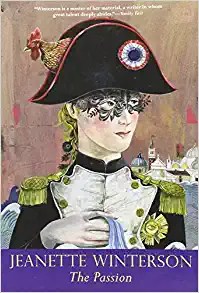
1. The Passion, Jeanette Winterson, 1987
This was my find of the year. I happened upon this book in a short article on NPR Books. I requested the hard to find title from Bangor Public Library on a bored whim. I had liked the way the author of the article (Stephanie Staal, http://www.npr.org/2011/08/05/133476730/three-gutsy-heroines-to-celebrate-womens-history) had made the book sound so unusual, sexy, and intelligent. I forgot about it entirely, and when the book showed up at the Maine State Library I turned it over in my hands having no idea why I’d requested it. Which made it all the more delightful when I read it and just loved the hell out of it. It is indeed unusual, sexy, and very well written, but to that I would add romantic, violent, heart breaking, funny, and beautiful. I don’t know what I loved more, the setting of a lunatic Venice, the bizarre & sexy leading lady, the unabashed melancholy of the prose, or the haunting way it lingers with me even now, but it is a precious and rare kind of a novel that everyone should take the time to read.
2. To the Lighthouse, Virginia Woolf, 1927
I read this novel for about the fifth time this past year. (That’s cheating! you may be yelling, but it’s my list and I can put whatever I want on it.) This book, always a massively enjoyable read for me, was particularly potent this year. I found myself startled anew by the way Virginia Woolf writes about the inside workings of my heart as if she’d studied the minutia of my secret thoughts for many lifetimes. It is incredible; she seems to mirror back our own lives, and does so with a precision that makes you feel dam near afraid, and to top it off, she does this in settings that are so far removed from our own day to day life, yet looses nothing in the transference, it remains pitch perfect. Her books are the writings of a master of both language and the nuances of suffering, and her works are genius.
3. A Good Man is Hard to Find, Flannery O’Connor, 1953
An author I had wanted to read for some time, so I was pleased when this collection of short stories was chosen for my book group’s summer read. Short stories are far and away my favorite thing to read, and this collection was everything I had hoped – brilliant, dark, funny, grotesque, haunting. She gives voice to the displaced, painting local color and human suffering and joy in one stark snapshot of life, shocking and sometimes grotesque, and of course haunting. Southern Gothic at it’s best, written by an amazingly honest and observant woman. She stands shoulder to shoulder with some of my favorites – Donna Tartt, Truman Capote, Carson McCullers, and William Faulkner.
4. The Age of Innocence, Edith Wharton, 1920
I do love Classic Literature and I was eager to read this well loved and much praised story of life in the upper crust society of New York circa 1870. And though I knew I would like it, I ended up absolutely adoring it. The final scene of this book is what I would call a delicate mind blower, and it gives perfect expression to an absolutely indefinable experience. The book is quick, engaging, amazingly complex and well written, and it leaves you feeling like you know something very slippery and beautiful and important in a way you will never lose. A must read for the classical lover of love.
5. A Lesson Before Dying, Ernest J. Gaines, 1993
This book should have been a grind to get through, given the dark and ugly content and the impossibly unlikeable characters, but despite (or perhaps due in part because) these gruesome details and ornery folks I found it to be a perfect story, woven like good poetry, turning the cumbersome and filthy frenetic into a single note that goes off in your gut like a revelation. Gaines shows a deep understanding of the human psyche and a comprehensive sense of place, both literal and metaphorical. It is a really involved and complicated grouping of emotions, ideas, and facts turned into this simple, heart breakingly elegant story. Exceptionally honest and compassionate.
And for those who love lists like I do, here are the rest of them, ordered from favorites down to the despised :
6. The Golden Notebook, Doris Lessing
7. The Fountainhead, Ayn Rand
8. Gunnar’s Daughter, Sigrid Undset
9. The House of the Spirit, Isabel Allende
10. The Complete Stories of Truman Capote, Truman Capote
11. Full Dark No Stars, Stephen King
12. Siddhartha, Herman Hesse
13. The Magus, John Fowles
14, The Complete Works of Flannery O’Conner, Flannery O’Conner
15. Jonathan Strange & Mr. Norrell, Susanna Clark
16. Diary, Chuck Palahniuk
17. The Elephant Vanishes, Haruki Murakami
18. Oranges are not the Only Fruit, Jeanette Winterson
19. 11/22/63, Stephen King
20. The Once and Future King, T. H. White
21. Palace Walk, Naguib Mahfouz
22. The Hunters, Claire Messud
23. Eat, Pray, Love, Melissa Gilbert
24. The Memoirs of Catherine the Great
25. Madame Bovary, Gustave Flaubert
26. Nine Lives, William Dalrymple
27. Homage to Catalonia, George Orwell
28. Barabas, Par Lagerkvist
29. The Dwarf, Par Lagerkvist
30. We Tell Ourselves Stories in Order to Live, Joan Didion
31. Angle of Repose, Wallace Stegner
32. Squirrel Seeks Chipmunk, David Sedaris
33. Haunted, Chuck Palahniuk
34. Incidents in the Life of a Slave Girl, Harriet Jacobs
35. Brave New World, Aldous Huxley
36. Julian’s House, Judith Hawkes
37. Mein Kampf, Adolf Hitler
38. William Faulkner, Carolyn Porter

