Welcome to Thibeau on Film, a blog about movies and how I feel about them. And yes I am using the word film to be pretentious. And yes I am bringing up of my ironic use of the word film to be unbearably pretentious. Before we dive in to today’s films let’s talk about why I am writing this movie blog.
The story of why begins way back. Back when I was born, in 1981. Well, no, that’s a bit too far back. Let’s go to the late 80s in suburban NJ. I’m a kid here, under ten, and we have a VCR in our home, and a collection of tapes. Those of you of a certain age will know what I am talking about. We went out to rent videos, sure, but in the house we had maybe 20 tapes, purchased seemingly all at once. Occasionally we’d buy something new. Or tape something new off the TV. But the meat of this collection remained the same for a decade. And I watched the absolute crap out of these movies. My favorites would shift as the years clicked by, but I watched all of that collection down to the bone. To give you a sense of what was in the mix, we’re looking at: Top Gun, Labyrinth, Gone with the Wind, all 3 og Indiana Jones, Ghostbusters, Fatal Attraction, Dead Poets Society, Mac & Me, all 3 og Star Wars, some older Disney like Sleeping Beauty and Sword in the Stone, Look Who’s Talking, Animal House, etc. So a diverse mix. I watched all of them. It was the 80s and kids just watched everything. Trust me, it was fine. Media has changed. You probably haven’t even noticed. But yeah, things have changed big time.
I’m 40 now and I am a bit out of step with the world. I have a TV with a digital antenna (any Comet fans out there, holla!), and a DVD player. I don’t have WiFi at home, and I don’t stream at home. I do have a smartphone but it can’t support streaming anything beyond a short YouTube video. I watch Netflix and Prime when I visit friends (Yes, I’ve seen Stranger Things). I once house-sat and they had Hulu and it was heaven (Pen13 and Shrill for days). But my point here is I love movies and the way I watch them mostly is to borrow them from my local library. Gardiner Public Library, here in Gardiner, Maine, has a really phenomenal DVD collection. I also frequent Bullmoose, a locally owned music and movie store (with a big section of used DVDs, CDs, and books). So what I end up watching is a bit, odd, I guess. Which is what compelled me to write this movie blog. I watch so many interesting, amazing, frustrating, and surprising movies. And because of how I consume media they tend to be a bit off the beaten path. I’m deep in the weeds, when it comes to our media landscape. Here there be monsters, and forgotten wildness. But these movies are also often remarkable, and worth looking into if that’s your thing, so I am going to share them here. Not everything will be old, or unpopular, I just go where my heart and the DVD collection leads.
And one more thing before we dive in, there are two podcasts I’d like to shout out: I Saw What You Did with Millie De Chirico and Danielle Henderson, and You Are Good with Sarah Marshall and Alex Steed. I haven’t necessarily watched all the films they’ve reviewed, but the way they choose, talk about, and love movies has changed the way I think about my own love of movies. It’s deepened my own relationship with film. I owe gratitude for that. Hearing other people get excited about and be effected by movies is really fun, these are exceptional podcasts and you should check them out.
Today, for the maiden voyage of Thibeau on Film, I’d like to talk about, Chaplin, the 1992 movie, directed by David Attenborough, and staring Robert Downey Jr., and The Great Dictator, the 1940 comedy; written, directed, produced, and staring Charlie Chaplin. Both of these are available on DVD at the Gardiner Public Library.
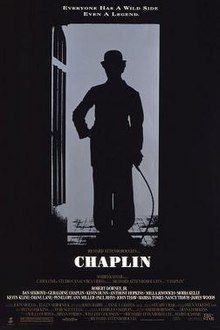
I watched Chaplin first, on a whim. The film is a biographical drama about the life of British comedian Charlie Chaplin, king of the silent movie. I went in knowing very little about Chaplin. I was familiar with his tramp character, and had seen him in a few shorts. But I didn’t even know he was British, so, I went in pretty fresh. This movie got mixed reviews, and didn’t do well at the box office. However, Downey’s performance was critically acclaimed and he got a BAFTA for the role. I had just read a novel about a vaudeville pair, Niagara Falls all Over Again, by Elizabeth McCracken, so I guess in a way I was primed for something set in the silent era.
The movie begins with Charlie’s childhood. His father was absent, and his mother, who also performed on the stage, was unstable mentally and struggled to provide for her family. Eventually she is institutionalized. Charlie and his brother fend for themselves in work houses and in vaudeville. Charlie is particularly adept at physical comedy, and becomes a star, locally. As a very young man he sets off for America (to do live performance circuits) leaving behind a young girl whom he loves.
In America Charlie seemingly shows up in Hollywood as it’s being built. The movie industry is brand new, and sound-stages are literally in construction. He gets work on silent films and the rest is basically history. He ends up writing and directing his own stuff, and he becomes rich and famous and eventually he has his own production company. There is a scene where he is at an industry party and refuses to shake hands with a Nazi. A friend laughs at him and tells him he looks a lot like Adolf Hitler, and in fact Hitler and Chaplin are the same age, born in the same month/year. This is apparently the seed that would sprout Chaplin’s movie The Great Dictator. Which we’ll get to later.
The other narrative of the movie is that Chaplin has a foible, that being very young women (mostly actresses in their teens). They sort of try to link his proclivity towards young women to the loss of his early love (that girl he left behind who we later find out dies of influenza) but this is pretty clunky. He just likes to date very young women and it becomes more and more inappropriate as he becomes older and richer and more powerful. He marries one after the other, often to avoid scandal around pregnancy. So he is a dog, and a bit of a predator. Eventually this ongoing drama with underage girls leads Joseph McCarthy, who has been investigating Chaplin for supposed communist sympathies for awhile, to blackmail him out of the country. He goes to Switzerland, and lives there for the rest of his life. With his 4th wife I think. He has a million kids.
Downey’s performance is excellent. I had to google around to find some video of Charlie Chaplin not performing to get a sense of just how good. Chaplin’s manner of speaking (very soft, with a British accent that hits oddly given his refinement of speech, and the affected “mid Atlantic” Hollywood accent of the time layered on top) and the way he moves are specific and a bit unusual. In real life Chaplin was very handsome, and extremely fit (he had the body of an acrobat as a young man.) Downey nails it. And his physicality is spot on. It must have been a challenging role to take on. He also has to play him from 20 to 80, so it’s a lot. The film ends with Chaplin receiving a lifetime achievement award in 1972. It’s very moving.
I thought the movie was very good. It was entertaining, and interesting. Seeing some behind the scenes stuff from early movie production was fascinating. Thinking about how that industry has grown and changed in the last 100 years is really mind blowing. The gowns and dress of 1920s Hollywood are a personal favorite for me, so I loved that element. A criticism of the film is that it was a sentimental whitewash job. I don’t know enough about Charlie Chaplin to directly speak to that, but it’s a biopic. It’s was written around Chaplin’s own autobiography (where he famously leaves out A LOT of stuff, like an entire marriage), and a glowing biography written by a film critic that clearly adored him. So. It is what it is. If you’re looking for a gritty documentary about the real Charlie Chaplin this probably will infuriate you. But if you’re a more casual viewer I think there is a lot here to enjoy. And it’s worth mentioning that this film does not address any issues of race or gender in Hollywood (and it doesn’t dig too deep on Chaplin’s own issues with women). It is about a very wealthy and successful white man. So again, it might not be what you’re looking for.
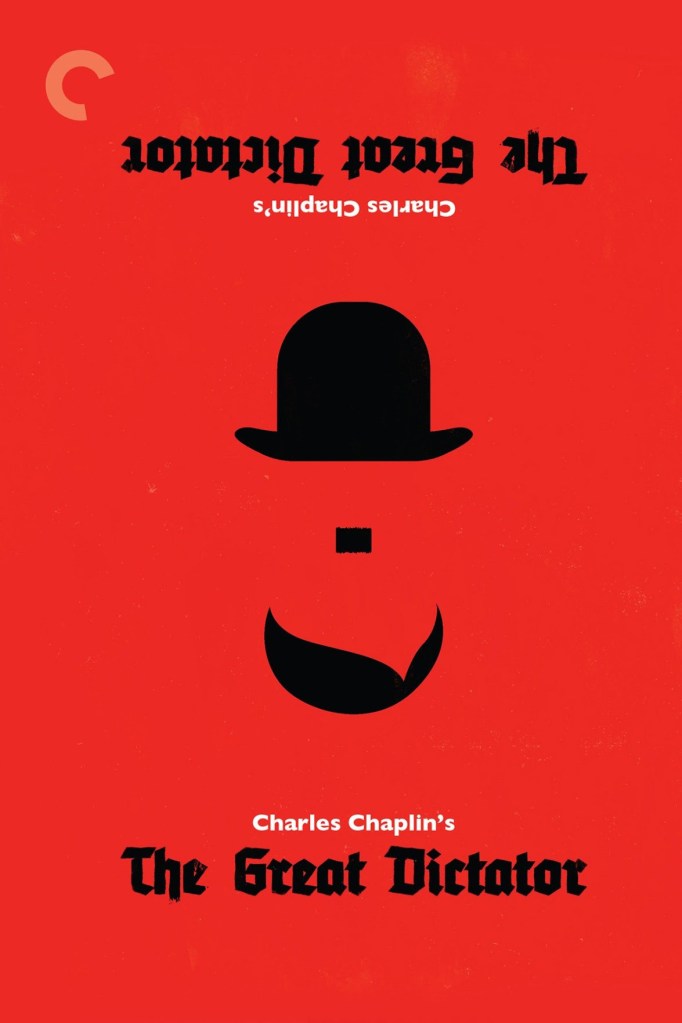
In researching Charlie Chaplin a bit more I began to watch some of his movies. I found several short pieces online. Then I found The Great Dictator at the library. Criterion collection, bitches! So The Great Dictator was written, produced, directed, scored and stared Charlie Chaplin. It was Chaplin’s first and only true talkie. As in there is sound, it’s not silent. It is his most commercially successful film, and is today considered one of the best comedy/satirical films ever made. It is a condemnation of Hitler, Mussolini, fascism, antisemitism, and Nazis. And it’s worthwhile to note that when it was released in 1940 the United States was still formally at peace with Nazi Germany. Which is mind-blowing really, considering the content of the film.
Chaplin plays two roles, that of a Jewish barber, and a fascist dictator called Hynkel. The setting is farcical (made up countries) but it’s clearly Germany and Hynkel is clearly Hitler. The barber is hurt in a war and losses his memory for 20 years. When he returns to his home/barbershop, his neighborhood is now a ghetto. The barber is unaware of the new laws in the ghetto that apply to Jewish people. So a series of funny yet kind of terrifying encounters with storm troopers ensue (did you know that storm trooper was a Nazi term for a specially trained violent soldier? I thought that word was invented by George Lucas, and when they kept saying it in this 1940 movie I was like…whut.) The storm troopers paint JEW on the front of businesses, they harass and plunder and just act like beasts. The barber is baffled by them and then becomes angry and they end up fighting. The barber throws paint in their faces. It’s very funny but also harrowing given the context. Then the beautiful and captivating Paulette Goddard (a citizen of the ghetto) whacks a storm trooper over the head with a giant iron frying pan to help the barber. Then she accidentally hits the barber too, and he dances down the street, in a silly daze. Spoiler, these two will soon fall in love. Eventually in a later encounter between the storm troopers and the barber they attempt to hang the barber from a light pole. Like with a noose. But who should show up but an officer who is also an old friend of the barber’s (from that earlier war where the barber was injured and got amnesia). He stops the hanging (Since when are we hanging people in the streets he asks, in a dark precursor to things to come) and things seem to get better for the barber. For awhile. Till they burn down his barbershop.
The scenes with Hynkel are even more funny and scary. Hynkel sexually assaults his secretary, is clumsy, and stupid, gets in a food fight and is obsessed with putting on a show of power. He tries to borrow money from a wealthy Jewish Banker to finance his continuing campaign of military power. But the Banker denies his loan and Hynkel decides to purge the Jews out of the ghetto. This is when the barbershop gets burned, and Paulette Goddard and her family flee to the country, while the barber is sent to a work camp. A concentration camp, basically. Another aside, Chaplin didn’t know about the mass murders being enacted at the concentration camps at that time. And he said he isn’t sure he could have made the movie had he known. Information about what was actually happening at the camps came to light later, after 1940.
There is a beautiful scene where Hynkel plays with a giant inflated globe. He dances with it, tossing it up, bopping it with his foot, and eventually lays belly down on his desk and bops the globe up with his bottom. It’s an oddly captivating and effecting scene. It mocks Hynkel, but it is shadowed by the horror of a man like that having the fate of the world in his inept hands. He’s a fool and a child.
Later the barber escapes the camp in a stolen uniform. Hynkel is mistaken for the escaped barber and sent to the camp, while the barber ends up at a giant rally. He has to speak, they think he is Hynkel. So the barber gets up, and with his weird Charlie Chaplin voice (his real voice it seems, as it is noticeably different from the voices he uses for either Hynkel or the barber, and sounds like the voice Downey captured in Chaplin) he gives this beautiful little speech. He says, he, Hynkel, has had a change of heart. He wants them to unite in brotherhood and goodwill towards all humans, to come together and fight for liberty and democracy. And the people cheer. Like all political speeches it lacks any real policy or details. But again, given the context of when this film was made it is hard to not be moved by the simple sensibility of treating people like people, and choosing to NOT wipe out an entire group for some arbitrary reason.
It’s a hell of a movie, honestly. Funny, really funny. Beautifully shot in black and white. Bold. It’s a bold piece of film. The performances by Paulette Goddard, Jack Oakie, and Reginald Gardiner are outstanding.
For me these two films have been the tip of an ice burg. I’m now on a journey to experience more of Chaplin, more silent films in general, and I’m on the hunt for a good (and more in depth) Charlie Chaplin biography. I highly recommend either/both of these DVDs. It’s a long winter folks, watch some good films.


Boy I remember my mother bringing me to work during the summer and going to the palace theater in Danbury CT to see the matinees of the latest hits: Bad News Bears, Herbie the Love Bug, and Close Encounters, Kramer vs Kramer.. From then I was in love with the cinema. My latest anime favorite is ‘weathering with you’, what a gorgeous film! Love the blog!
LikeLike
I’ll definitely check out Weathering with You. Thanks!
LikeLike