
I guess you might say I’ve entered my Grandpa stage of life. After watching a bunch of Clark Gable movies (mostly filmed in the 1930s), I decided to move on to Humphrey Bogart. I had never actually seen an entire Bogart film, so I watched ten of them. I do think I may have gotten lung cancer just watching them, as Humphrey Bogart is smoking constantly, like in pretty much every single scene, in every single movie. In Dark Passage his character has plastic surgery on his face and his head is wrapped in bandages, and Lauren Bacall’s character gets him a special cigarette holder so he can continue to smoke even when he can’t speak. It’s hilarious. But before we dive into my four favorite films, some groundwork.
Humphrey Bogart was born on Christmas Day in 1899 to a wealthy family in New York. He failed out of private school and enlisted in the Navy, and served in World War I at only 18 years old. After returning home he joined the Coast Guard Reserve and worked as a shipper. He enjoyed jazz and drinking, and spent late nights out at clubs, where he began to socialize with actors. He later said of acting, “I was born to be indolent and this was the softest of rackets.” He began to act, first in plays and then he headed to Hollywood in the 30s. His film career was slow to start, he played bit parts, and an endless slew of unmemorable gangsters in B movie crime dramas. Although he began to get some notice in films like The Petrified Forest (1936) and Black Legion (1937) it was his performance in The Maltese Falcon (1941) that launched him into stardom. The film was the directorial debut of John Huston (a drinking buddy of Bogart’s, the two would go on to make many films together), and based on a novel by Dashiell Hammett. The actor George Raft was intended to play the lead, Sam Spade, but he turned down the role. And history was made. The film is a masterpiece, and one of my favorites of those I watched. Then came Casablanca (1942) which launched Bogie into the stratosphere, and is considered to be one of the best movies ever made. More on that later. What I want to get into is Bogart and Bacall.
Although I loved Maltese Falcon and Casablanca, I find myself really drawn to the movies with Lauren Bacall. Bogie and Bacall met filming To Have and Have Not (1944). Bacall is only 19 in the film, it is her acting debut, and she steals the entire show. Or rather her chemistry with Bogart steals the show. The two are electric together. So electric that Bogart left his third wife and married Bacall the following year. They would go on to make four films together. Their relationship was full of drama, and affairs, but also considered one of the great Hollywood love stories. They would have two children together and remain married until Bogart’s death, of esophageal cancer, in 1957. Humphrey Bogart was a heavy smoker (as is evident by his nonstop smoking in every film he ever made) and an alcoholic, he was only 57 when he died. And one final thing to throw in, Bogart was one of the founding members of The Rat Pack. The story goes that in 1955, during an epically long party in Vegas attended by Frank Sinatra, Judy Garland, Sidney Luft, Michael Romanoff, David Niven, Angie Dickinson, and Bogie & Bacall (among others) the group was formed with the mission: “To drink a lot of bourbon and stay up late.” So, there you go. Today Bogie is a cultural icon and one of the greats of classic American cinema. Let’s talk about my four favorite Bogie films.
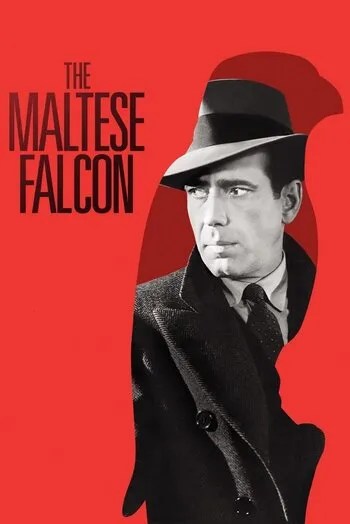
The Maltese Falcon, 1941, directed by John Huston, starring Humphrey Bogart, Peter Lorre, Mary Astor, and Sydney Greenstreet. Based on the 1929 novel by Dashiell Hamett. I love the classic noir look of this film, the sharp black and white, the use of shadows; the iconic private eye character of Sam Spade (Bogie); the classic femme fatale who brings trouble with her in the door (Mary Astor as Miss Wonderly); the intriguing collection of characters like Mr Cairo (Peter Lorre) and The Fat Man (Sydney Greenstreet); and the tangled web of crime and intrigue. It sure does play all the hits. Sam Spade and his partner are private detectives, and one day Miss Wonderly wanders into their office and tells them a tale. Her sister has run off with a man, and she’s desperate to find her. She’s traveled all the way to San Francisco, but now she can’t locate her sister, and she needs help. She gives them the name of the man the sister is supposedly with, and a stack of cash. Sam’s partner tails the guy, but ends up dead. Sam is less upset than you’d think by this quick and brutal turn of events. He didn’t like his partner much, and was sleeping with the guy’s wife. So. Sam is now a suspect. Then who bursts in but the weird Mr Cairo, who threatens Sam, and seems to think he knows where some valuable object is. It’s tied in with the guy they were tailing (who has also been murdered), the one that maybe shot his partner. Sam confronts Miss Wonderly. It seems she wasn’t honest about her situation. She’s not looking for some lost sister, but this valuable object, the same one that Mr. Cairo seeks. Then we meet The Fat Man, and guess what, he’s looking for the object as well. We learn that the object is a bejeweled statue of a Maltese Falcon, and is worth ever increasing amounts of money as the film progresses. Everybody wants it. But where is the damn thing? Here we get the Bogie we’ll all come to love. The constantly smoking, trench coat wearing, cool, aloof, one step ahead guy with the great delivery. I think the real magic of Bogie is his voice. Within the timbre and pacing of his voice is the soul of the 1940s. You also get the classic close ups of Bogie’s face as he works out what int he heck is going on. These close face shots will be a trademark as his career continues.
This film is pretty much perfect, and is the standard for classic noir to this day. It is engaging, and it looks beautiful. A can’t miss if you’ve yet to watch it.
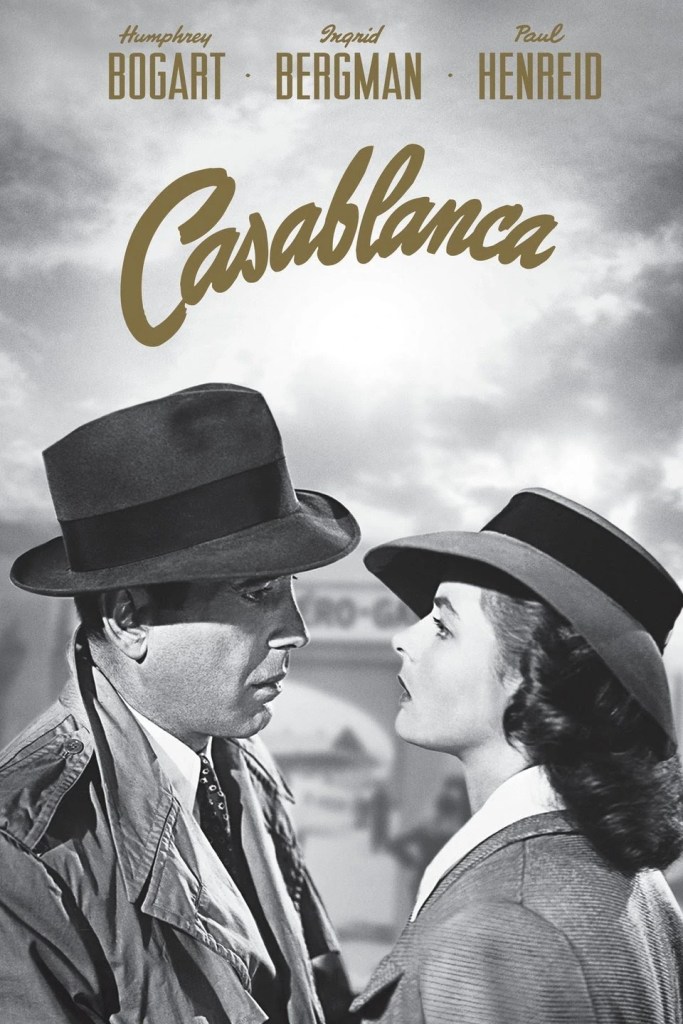
Casablanca, 1942, directed by Michael Curtis, staring Humphrey Bogart, Inrgrid Bergman, Peter Lorre, Dooley Wilson, Paul Henreid, Claude Rains, and Sydney Greenstreet. I thought for sure I had seen this movie as a kid, but when I sat down to watch it I realized I absolutely had not. The only thing familiar was the final scene on the tarmac where Bogie gives his famous parting speech, which is arguably one of the most famous scenes ever. This movie is set (and filmed) during World War II and opens by explaining that many refugees, fleeing the German occupied areas, end up in Casablanca, Morocco, with the hopes of finding safe passage from there to neutral Portugal or the United States. This requires paperwork that most people cannot obtain (or afford) and they end up stranded in Casablanca, which is under Vichy French authority. The hot spot to hangout in Casablana is Rick’s Place, and Bogie is Rick, the owner. In Rick’s people drink and dance and gamble and try to make deals to get out. Enter Ugarte (Peter Lorre, remember him, Mr. Cairo? He is a fascinating actor.) who has murdered some German officials and stolen some papers of passage, highly valuable. Ugarte convinces Rick to hide the papers for him, just for a few hours. But then Ugarte is captured and killed by the French police (who are corrupt, and being pressured by German officials.) So now Rick has the papers, but nobody knows that (or not for sure). So into this mess walks Ilsa (Ingrid Bergman) and Victor (Paul Henreid). Ilsa is accompanying her husband Victor, who is a Czech resistance leader, and wanted by the Nazis. Victor was supposed to meet Ugarte and get those travel papers. While Victor learns of Ugarte’s death, Ilsa calls the piano player, Sam, over (he wheels his piano over to her table, which was funny). The two seem to know each other, from Paris apparently, and Ilsa asks about Rick. It’s awkward. Then she asks Sam to play “As Time Goes By”. Sam pretends he forgot the song, but she persists, and she’s just as pretty as can be, so he gives in and begins to play. Rick comes storming over. This song is forbidden at Rick’s. Rick sees Ilsa. And it’s clear that the two know each other. Ilsa is in fact the reason Rick is such a jaded crab. She broke his heart. There’s a fairly long flashback montage of the two of them just having a ball in Paris, which ends when she ditches him, in the pouring rain, at the train station (they have to flee cause the German’s are invading). So cut back to current day, at Rick’s. Victor needs those papers, there are German officials in Casablanca ready to arrest him. He finds out Rick has the papers and asks for Rick’s help. Victor is heroic, a leader of a group resisting the Nazis, he now has Ilsa by his side, and we find out he was in a concentration camp (and married to Ilsa) while Rick and Ilsa were frolicking around Paris. (Ilsa had thought Victor was dead (for part of the time anyway.)) And Rick is a club owner, and a pessimist who doesn’t stick his neck out for nobody. What will Rick do?
This movie is moody, and melancholic. From the tinkling of “As Time Goes By” to the sad stories of all the refugees fleeing war, trying to find safe harbor, and mostly getting chewed up by a corrupt system that only honors cash, it’s drenched in woe. People in Casablanca are biding their time, homesick, heartsick, and surrounded by predators looking to take advantage of their plight. Rick is a man who pretends to be hard but isn’t. Ilse is a woman who can’t be trusted, frankly. And Victor is selfless to the point of being kind of soulless. There aren’t any good outcomes here, not entirely. But you do get a Hollywood ending of sorts. I honestly loved it. It wasn’t what I thought it would be, and I feel lightly haunted by it.

To Have and Have Not, 1944, directed by Howard Hawks, starring Humphrey Bogart, Lauren Bacall, Walter Brennan, and Marcel Dalio. Loosely based on the 1937 novel by Ernest Hemingway (Hemingway and William Faulkner worked on the screenplay for this, which is wild. Two Nobel laureates in literature cobbling this thing together! Wow.) So Bogie has been a private eye, a club owner, and now he is a fishing boat captain. Of all his roles this one was the hardest to swallow. I read the Hemingway novel years ago, and I always pictured a Hemingway type as the Harry, and a Hemingway type Bogie is not. But putting that aside I loved this film, for one reason and one reason only, and that is Lauren Bacall.
Harry (Bogie) operates a fishing boat that rich guys rent out to fish marlin off of Martinique. We’ve got more Vichy French here, as Martinique is a french colony in the Caribbean. Harry has a first mate Eddie who is an end of the line rummy, not good for much on a boat, but Harry looks after him. They take out a rich guy to fish for a few days and now the guy owes Harry money, which he says he’ll get to him in the morning. Harry goes back to the hotel he lives at and the owner urges Harry to help with the French resistance, by smuggling some people onto Martinique. Harry says no. Then we meet Slim (Lauren Bacall). Slim is a lone traveler who has washed up here in Martinique. She sings a song and makes eyes at Harry. She is an absolute smoke show. During the filming of this movie both Bogie and the director Hawks (both twice her age and married to other women) fall in love with Lauren Bacall, and it’s understandable, you’d have to be made of stone to not fall in love with her in this role. She smoulders, she teases, she is electric, she is a movie star. Her voice, her look, her eyes, her whole deal is perfection. At one point she turns to Harry and says, “You know how to whistle, don’t you? You just put your lips together…and blow.” The line lands like a sex bomb, leaving your ears ringing after. So anyway, Harry sees Slim pick that rich guys pocket, and confronts her. Mainly cause the rich guy owes him money, so he’s looking out for his own interests. But then Harry finds a plane ticket in the rich guys wallet for first thing in the morning. The rich guy was going dine and dash on his fishing bill. Harry confronts him and is about to get him to sign over some traveler’s checks (throw back) when a stray bullet from a Vichy police and resistance fighters skirmish takes out richy rich. So Harry is screwed. So now Harry agrees to move the resistance fighters, cause he needs the cash. He uses some of this cash to buy Slim a ticket back home. Then he goes off in the boat and picks up this resistance couple. They get shot at by some officials and the head of the resistance is injured, but they get back safe. They hide the resistance couple in the basement of the hotel, and Harry turns into a doctor and helps the injured man. Then the Vichy French police show up and reveal they have Eddie (the rummy) and are withholding drink from him, which could kill him given his severe alcoholism. They want Harry to admit it was him and his boat that brought the resistance couple over, and to give them up. But Harry ain’t no chump. It may have been about the money to start but now he wants to help. The Vichy French are infringing on his independence, which he values highly, and abusing their power on the island. Harry is in it now. He ends up killing an officer, releasing Eddie, and grabbing Slim as they head out to his boat to flee.
This movie is worth the watch just to marvel at Lauren Bacall, she is like a miracle, and I can see how this launched her career. Their chemistry is a delight. It strays very far afield from the novel (which was set in Cuba, and ends on a completely different note.) but it wasn’t that good of a novel anyway, and the film is much better.
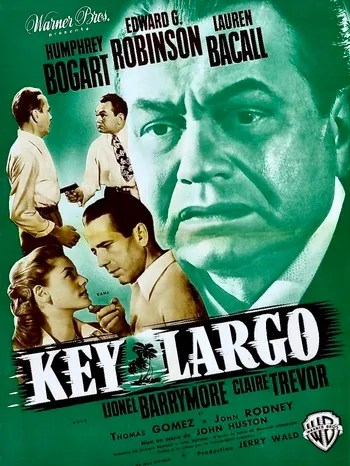
Key Largo, 1948, directed by John Huston, starring Humphrey Bogart, Lauren Bacall, Edward G. Robinson, Claire Trevor, Lionel Barrymore, Jay Silverheels, and Monte Blue. Based on the Broadway play of the same name written by Maxwell Anderson. This is a fascinating one. Where many of Bogie’s roles are shiftless, apathetic, and too cool for school, with a bit of the anti-hero thrown in, the role of Frank McCloud casts Bogie as a good guy. A war hero, and a morally upright man not afraid to stand up to a group of gangsters (which is ironic as many of Bogie’s early roles were as gangsters). The head gangster is played by the incomparable Edward G. Robinson. If you’ve ever seen someone do an old school mob boss impression they’re probably doing Edward G. Robinson, for he is the king of this thing (until The Godfather hit the scene anyway.) His performance here is unbelievably good. In fact all the actors in this thing really turn it up. It feels very much like a play (which makes sense as it’s based on one), and puts an array of characters into a small space during a Hurricane. And all hell breaks loose.
So Frank McCloud rolls into a hotel in Key Largo in the off season (it’s hotter than heck). He is there to visit the family of a fallen war buddy, who spoke of his home in Key Largo, and his wife and father, in his final moments. The widow, Nora Temple, is Lauren Bacall, and the father, James Temple, in a wheelchair, is the legend Lionel Barrymore. A group of mobsters are staying at the hotel, even though it’s ostensibly closed. It’s a tense situation, but the mobsters are supposed to be leaving. Unfortunately a hurricane is on it’s way. As Nora and Frank prepare the hotel and boats for the storm, some local law shows up, they are looking for some native American Indians, the Osceola brothers, accused of theft. Soon after the cops leave some Seminole Indians arrive seeking shelter from the hurricane. But just then Frank, Nora, and the father James are taken hostage by the gangsters. Turns out they grabbed one of the local cops, cause gangsters just don’t want cops around. The head gangster, Rocco, who has been hiding upstairs until now, is revealed. Rocco (Edward G. Robinson) is a trip. There is a long scene where he delivers a monologue while being shaved by one of his men with a straight razor. It’s deeply entertaining. Rocco isn’t worried about this storm, at all. He has to meet some other Gangsters and exchange some money or something, and he tells them on the phone to ignore “the rain” and come right over. They also kill the cop they’d grabbed earlier and dump him in the sea. The storm is in full swing now and everyone is trapped inside, power is out, shutters are on the windows. It’s tense.
The next scene is so amazingly good. Rocco has a lady friend with him, Gaye (played by Claire Trevor). She used to be his girl, when she was a young up and coming singer, but now she is older, a drunk, and a bit of a pathetic figure. Rocco, who is clearly a sadist that enjoys hurting people, refuses to give Gaye a drink unless she sings for them. He knows her voice is shot, but he forces her to do it anyway. Claire Trevor’s performance here is remarkable, vulnerable, brilliant, and heartbreaking. Rocco still refuses her the drink, saying she was lousy. Frank McCloud gets up, pours her the drink, and puts it in her hand. He’s bucked the hierarchy, he’s made his stand. Rocco seems pissed, slaps Frank right in the face, but he gets distracted by the storm, which is now wailing, and he becomes nervous, and afraid, pacing and murmuring. As the storm begins to subside the Sheriff shows back up and finds the body of his partner, the storm washed the body right up in the dooryard. There is confusion as the gangsters play dumb, and poor old James Temple is accused of hiding the Osceola brothers, who the sheriff now believes killed the deputy. So the Sheriff kills the Osceola brothers. Rocco is gleeful at this gross injustice. Then his gangster buddies show up and they make the exchange. Rocco now commands Frank to ferry the gang to Cuba. Gaye pulls Frank aside and warns him Rocco will kill him when they arrive and that he should run. So the gang and Frank get on the boat. I won’t spoil the ending, but I’m sure you can guess that they don’t make it to Cuba.
This movie is jam packed with outstanding performances. It has the claustrophobic intensity of a “theater of the absurd”, with melodramatic dialogue and all the way up to 11 acting. I found it very engaging and was surprised over and over at the amazing work of all the actors involved.
A few more honorable mentions. Dark Passage, 1947, a Bogie and Bacall crime drama. This was a fun one. The setting is San Fransisco (one of my favorite cities), Bogie plays an escaped convict, wrongly accused of murdering his wife. The first half of the film you don’t see Bogie’s face, and his scenes are filmed in first person. Odd choice. Then he gets plastic surgery and recuperates in this fabulous art deco apartment belonging to Bacall’s character. She’s a wealthy, single, and sympathetic artist. The premise is silly, but the look of the thing is great. Beat the Devil, 1954, directed by good ‘ol John Huston. This is a later Bogie, and it is loads of fun. A phenomenally weird ensemble cast including Peter Lorre (looking old but delivering on the goods as always), Robert Morley (a delight), Gina Lollobrigida, Jennifer Jones, Edward Underdown, and Peter Sellers (who is a creep, but I forgive it cause his part is small and he wasn’t indulged around his nonsense.) Bogie looks old, his teeth are a mess, but he is still great. This is a really funny and entertaining caper. And then The Treasure of the Sierra Madre, 1948, which is deep Grandpa territory. Everything important to be said about this one was done much better than I ever could by Danielle and Millie, on the podcast “I Saw What You Did”, episode 47. Bogie looks like he is dying, full on. Gold fever is real. Need I say more.
Thanks for coming along for the ride. I was surprised at how good these movies are. As usual, when you dig into something it is often more than you expect. Humphrey Bogart was a great actor, a man of his time, and is loads of fun to see on screen. I’ve only seen ten of his 75 or so films, so there’s more to explore. I’ll keep you posted.
 Thibeautown
Pingback: 2023 Book Blog | Thibeautown