Found money brings bad luck.
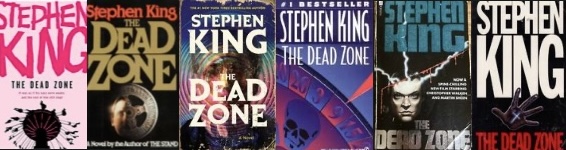
The Dead Zone is Steve’s 7th novel, and was published in 1979. The dedication, to his son, reads, This is for Owen, I love you, old bear. I have found all of the dedications in these early books incredibly touching. Steve is now (in ’79) an extremely successful author, moving into a new era of his life and his writing, and that tracks in this book. Joe Hill has stated that this is one of his favorite novels of his old Da’s work and that he revisits it often. Which is fascinating. I have thoughts. Let’s get into it.
So I read this once before, in my twenties, and I remember liking it, rating it right in the middle of King’s overall catalogue, and I remember the prologue of this book, vividly, and it is famously the thing King has received the most angry letters about in his career. This read through the writing in the book stood out to me, especially in contrast to what I’ve covered so far. The Shining is like a blow torch. And ‘Salem’s Lot is like a lush, overgrown garden. But in The Dead Zone the writing is like a stark cold room, up in the eaves of an old farmhouse. And the author is up there pounding away on a typewriter, and can hear the sounds of a family downstairs, where the stove is going, and life is happening, but they are up, working, writing, remote. The rhythm of The Dead Zone is more staccato, it is a complex, and a very good story; but it feels very different. I think I missed the beauty. I found the writing in The Shining and ‘Salem’s Lot very beautiful (in The Lot an enchanting beauty, and in The Shining a powerful beauty) but The Dead Zone operated on a different level. It was harder for me to get lost in. I felt more removed.
The story itself is excellent, and coming into my fourth read of this project I am taken with how good Stephen King is at story. His plots are powerful and they move with grace (especially considering the scale of them), so you can’t help but get swept up because he is telling you something pretty damn interesting, always. The book has three main threads and one is John Smith, and his girl Sarah. Johnny already has a bit of the shine, from falling directly on his head and knocking himself out ice skating as a kid, and he’s got his whole life ahead of him. Johnny is the beloved school teacher, out with his favorite girl at the fair where he wins some big cash at the gambling booth (thanks to the shine). Huge wad of dough, honestly, even by today’s standards. But alas, these are the last good moments of a life that will be cut off at the knees. John Smith gets in a terrible accident in a cab that night, he hits his head and is in a coma for 4.5 years. His parents Vera and Herb have been through hell in that time, Johnny has been through hell and it continues as he awakens to a broken body and a changed world, plus Sarah went off and married Walt Hazlet. John also awakens with profoundly amplified clairvoyance, and a mere handshake can blast him with some heavy future downloads. All this causes problems for him, emotionally and logistically.
In thread two we have Greg Stillson. The infamous Greg Stillson. Bible salesman, rainmaker, real estate developer, local politician in New Hampshire with ambitions to a much higher office, momma’s boy, oh and the type of guy that will kick a dog to death out of spite. A dangerous clown. He has a posse of ex-bikers who cary sawed off pool cues (the imagery stuck with me), and thinks nothing of threatening and beating up anyone who gets in his way. We get vignettes of this man moving up the ladder using dirty practices. Greg and Johnny don’t cross paths till the last half of the book.
And thread three is Sherriff George Bannerman and The Killer (Frank Dodd) of Castle Rock. That’s right folks, we’re in fricken Castle Rock. Nod to its first appearance. Johnny gets called in on this serial killer case, and he uses his shine to solve it right fast, but the fallout is unpleasant. His abilities lead to nothing but sorrow, a through line.
When Johnny shakes Greg Stillson’s hand (late in the book mind you) he gets his strongest vision yet: Stillson is not the man he presents himself to be, but someone deeply violent and dangerous, who will someday become president of the USA. The future Johnny sees is catastrophic, war on an unimaginable scale. Reading this in 2001, when I was twenty, the storyline struck me as more hypothetical than frightening, an extreme moral dilemma built around an unlikely political future. In 2026 it lands very differently. The question at the center of the novel – whether Johnny should kill Greg Stillson or allow his destructive political ascent to unfold – feels more like an unnervingly recognizable ethical crisis. Age probably changes the reading experience, but history does too. It is satisfying to see Stillson show his true colors in the end. Johnny’s sacrifice feels real and necessary.
This book has a slower pace, and due to the choppy narratives feels stitched rather than grown. The threads resists wholeness, in some way. Johnny Smith is also a somewhat difficult protagonist. His fundamental goodness can feel a little heavy handed, at least to me. I tend to distrust characters who are too wholesome, as I am a dirtbag. But he does suffer, and I can appreciate suffering, and it does round him out into a more human shape. The question this book poses is a good one, and the story is well told. But I would move The Dead zone down in my overall rating a few ticks, from its previous standing right in the middle of the pack. I’m curious where how ya’ll feel about this book? Let me know.
Some bits and bobs: there is a Thibeault! (you’ll remember Donna Thibodeau from Carrie) a Mary Thibeault was killed in the accident that put Johnny in the coma. Also Johnny drinks cans of Pepsi at various points, grabbing a cold can from the fridge and gazing out the widow sipping away, and it made me realize how demonized full sugar soda is in my world, back in the 70s everybody was doing it! Just like cigarettes. A free for all with no moral baggage yet. And also there is this line, “Like many fat women, her voice was a high, buzzy reed instrument… ” – pg 269. Seriously sick burn to fat ladies, Steve thinks ya’ll sound like bugs in a bottle, every one of ya. There have been a number of great articles calling out Steve on his ham-fisted fat shaming (see what I did there.) Like this one https://psychopomp.com/fantasy/dec-2021-issue-74/all-the-kings-women-the-fats/. I see it and I see you Meg Elison. I also see a somewhat flat character in Sarah, who reminds me a bit of Susan in The Lot. Steve can write great female characters, but he sometimes doesn’t.
Up next we have Firestarter, a book I have only read once before, at about 15, and would rank in my bottom five overall. Will that change this revisit? Stick around and find out. Find all of my King Reread Project here.


Pingback: King Reread Project | Thibeautown