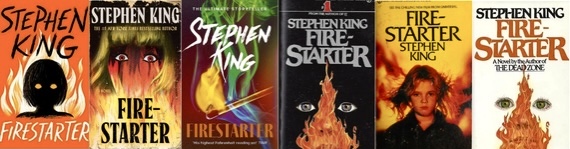
Firestarter is a science fiction thriller novel published in September of 1980. The book is dedicated to author Shirley Jackson, “In memory of Shirley Jackson, who never needed to raise her voice.” This is Steve’s ninth book, he is a successful writer (but not yet the legend he will be), with three young children (at this time Naomi was 10, Joe 8, and Owen 3) and by his own account a very heavy drinker and cocaine user. In Firestarter the themes of parental anxiety and distrust of the government are lit in neon lights. This book feels so deeply late 1970s in tone. And it’s hard not to track Steve’s drug use in his work where paranoia, government power, psychic ability, and social collapse are central, like The Shinning, The Stand, Dead Zone, and Firestarter. This was a time of intense creative output for King, but that torch was burning so hot it might be blowing out the conduit. An apt metaphor given what we’re diving into, let’s go.
- Andy McGee – The dad, has telepathy and mind control (the push) abilities.
- Vicky Tomlinson – The mom, had telepathy and some telekinesis, killed by The Shop.
- Charlie McGee – The daughter, has tremendous pyrokinesis abilities, is 7.
- Lot Six – drug given to Andy and Vicky during secret experiment by The Shop.
- The Shop – clandestine government agency.
- Dr. Wanless – in charge of the Lot Six experiments initially.
- Cap Hollister – in charge of The Shop.
- John Rainbird – Vietnam vet, fixer for The Shop, half Cherokee, only has one eye.
- Patrick Hockstetter – Shop agent in charge of testing on Charlie.
- Herman Pynchot – Shop agent in charge of testing on Andy.
- Irv Manders – Farmer who gets involved with the McGees.
We open the book with a chase scene in NYC. Andy is carrying his exhausted daughter through the streets of Manhattan, pursued by several men in suits. He jumps in a cab and uses his mind control abilities to “push” the cab driver into taking them to Albany Airport. When Andy pushes people it seems to damage his brain, causing severe migraines, bloodshot eyes, and numbness on his face. He frames this as a black horses racing around his skull tearing up grey matter. This is what I strongly remember from my first read of this book, Andy stumbling around with a raw and bleeding brain most of the time. A similar thing was alluded to in Carrie, where she harmed herself when overusing her powers, unto death. Andy and Charlie are able to walk/hitchhike/scam their way through until they end up at the Manders Farm, where the agents finally catch up to them and there is a confrontation where Charlie uses her powers to firebomb the farm and the agents. Everyone freaks out, and the McGees flee again, this time to an empty rustic family camp in Vermont, where they hunker down for a bit.
The first half of this book is the pursuit of the McGees, and cut in with this narrative is all the back story. Andy and Vicky met at college when they both volunteered for a psychological experiment. They were given a drug “lot six” and $200 (which in today’s money would be a cool $1,000). Things went sideways at the test (one guy clawed his eyes out), but they convinced themselves it had all been a hallucination, and proceed to fall in love and get married and have a baby. The drug left Andy and Vicky with lite abilities, like telepathy, mind control, and telekinesis, but their baby, it turns out, had an amplified dose, and was setting fires as an infant. They are wrecked by this, try to manage it, but mostly just scream and freak out so much that Charlie develops a severe phobia of using her powers, and this will define her personality later, when she is constantly fighting against her pathology of setting fires and her desire to do it (or need to do it). The Shop is tracking the family (and tracking everyone who was given Lot Six, most of whom are dead now from suicide) and they catch wind of Charlie’s baby fires. They want this kid. They eventually try to get Charlie, but end up killing Vicky. Andy gets a psychic flash of this and escapes with Charlie in the nick of time. So begins the prolonged pursuit.
“Somewhere inside that infant Hell, horses began to scream.”
The second half of this book is the McGees captured and held and tested on at The Shop facility in Virginia, which we’ll get into. The writing and dialog around The Shop and the agents is baffling to me, in that it is bad. I have to think that King made a conscious choice to write in this style, that he wanted this book to be a heavy handed thriller, with the feel of a made-for-tv-movie, and so he leaned into tropes and an almost purple dialog style that for me was both funny and deeply annoying. Just to give you a taste here are a few examples that stood out:
- “Hockstetter would have trouble following his nose to a shit-and cream-cheese- sandwich.”
- “White men look at their own pricks and see monsters.”
- “”Stop!” Jules bawled. “Stop, dammit! Stop shooting the fucking horses!”
- “When one section of the fence was dead he climbed over it and let himself down into the dog run. Two of them came for him. He grasped his right wrist with his left hand and shot them both. They were big bastards, but the Windsucker was bigger. They were all done eating gravy train, unless they serve that stuff up in doggy heaven.”
- “The head leaned back in Cap’s chair and laced her hands behind her neck. The man who was not a librarian eyed appreciatively the way her sweater pulled taut across the rounds of her breasts. Cap had never been like this.”
- “Good morning, Josie,” the elderly gent said. “Hi Cap, you’re running a little behind, aren’t you?” Pretty girls could get away with this; if it had been Duane’s day on the front desk, he would not have done. Cap was not a supporter of woman’s liberation. “My top gear’s sticking, darlin.” He put his thumb in the proper slot. Something in the console thudded heavily. “You be good, now.” “Well I’ll be careful,” she said archly and crossed her legs. Cap roared with laughter and walked down the hall.
Once captured (by a team led by John Rainbird who is now obsessed with Charlie, and has made a deal with The Shop where he will help them capture and manage her in return for him being allowed to kill her in the end, which is his fetish, and I do mean sexual fetish.) the two are separated and imprisoned at the Shops’ compound. Andy is drugged with thorazine and becomes apathetic and fat. Which brings me back to something I mentioned last blog, and wasn’t planning to harp on, but holy smokes is it all over act two of this book: Steve and his weird relationship to fatness/fat people. Andy gets fat, gives up, and looses his ability to push. He is “tipped over” and no longer of any use. He spends time thinking back to when he was running a Weight-Off business, helping people loose weight by “pushing” them into it. And we get this amazing paragraph:
“Mrs Gurney, who had borne her truck dispatcher husband four children between 1950 and 1957, and now the children were grown and they were disgusted with her, and her husband was disgusted with her, and he was seeing another woman, and she could understand that because Stan was still a good-lookin, vital, virile man at fifty-five, and she had slowly gained 160 pounds, going from 140 she had weighted at marriage to an even 300 pounds. She had come in, smooth and monstrous and desperate in her green pantsuit, and her ass was nearly as wide as a bank president’s desk. When she looked down into her purse for her checkbook, her three chins became six.”
Andy’s weight gain is mentioned over and over again and leads to one of my favorite lines in the entire book (Daddy you got fat!) This is Charlie’s internal dialog when she sees her father for the first time in more than six months. I found it bizarre and funny and very pointed. Another sticky storyline involves Herman Pynchot, the agent in charge of Andy. Once Andy decides to pull himself together he secretly stops taking his meds, but plays dumb for a bit, building back his push strength. Then he gives ol Herm a good hard push to try and get free. This creates a ricochet, or an echo, that becomes an obsession for the person pushed. It is alluded to that the echoes often are born from the dark and gnarly places in people’s subconscious. For Herm this becomes a weird amalgamation of his desire to cross dress (something he did in college, but had stopped doing when caught and humiliated for it) and a garbage disposal. It’s bizarre and leads to a haunting suicide, but it is also a little greasy and mean-spirited. Same can be said for the entire character of John Rainbird who is two dozen racist and classist tropes rolled into one, and presented as an inhuman monster. I kept trying to treat all of this as part of the novel’s pulpy, chaotic fun, but the body shaming, racism, sexism, homophobia, and most egregious, the purple prose, repeatedly pulled me out of the story.
Everything in this book is 1970s coded, and nothing more so than the end. Here come all the spoils. Charlie escapes from The Shop by burning almost everyone/thing down. Her father dies at the hands of John Rainbird (though it’s implied his brain was a bloody sponge anyway so he was toast). Charlie flees on foot and ends up back at poor Mander’s farm again. They shelter her for a bit (this is a long and unnecessary part to my mind) but she flees to protect them and goes to NY where she walks into the offices of (*drumroll*) Rolling Stone Magazine. I picture them giving her a Singapore Sling and lighting her cigarette while they interview her and blow up this damn story. She’s 8 now, so she’s ready for Hunter S. Thompson to enter her life.
Did I like this book more or less than my first time reading it? I would say less, and the bar was in Hell. This is definitely one of the catalog that is not for me. To be fair suspense, and sci-fi, and government conspiracy shit is not my bag. I found the characters mostly flat, I didn’t lock in with anyone, and our McGees were emotionally hysterical or dying a lot of the time, which stressed me out. I don’t have any children, but I can imagine that trying to keep a child safe from the huge impersonal systems that make up life must feel impossible and terrifying. It’s expressed here, and I appreciate that. But it’s a no from me, dog. Any Firestarter stans out there? Tell me why!
Up next we have Cujo, another book I have not cracked since I was a teenager, so we shall see how she plays. Thank you all for coming along for the ride. You can find all of my Reread Project here.


Pingback: King Reread Project | Thibeautown