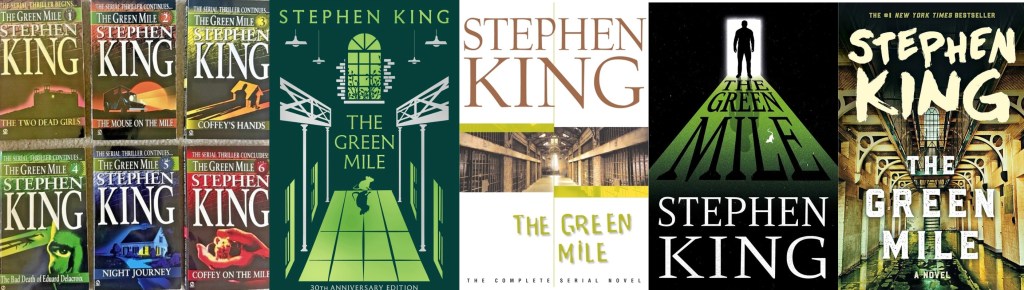
The Green Mile was published in six installments between March and August of 1996. All six paperbacks were on the New York Times bestseller list at once, a singular achievement. In spring of ’97 a single complete volume was published. The Green Mile won the Bram Stoker Award for best novel, and in 1999 the critically acclaimed film adaptation hit theaters. This is one King novel that I read early, working my way through the serial paperbacks at the Dr. Shaw Memorial Library when I was 15 years old. I loved it, and I loved the movie, which I saw in theaters. But I felt apprehensive about revisiting it. I hadn’t reengaged with this work in more than three decades, and I guess I worried I’d be disappointed. Let’s dig in.
The story is a first person narrative with dual timelines; Paul Edgecombe is telling us what happened at Cold Mountain Penitentiary in 1936, from a nursing home in 1996. This is a structure Steve uses to great effect in many of his novels and short stories; a person at the end of their life telling us the story, the story that, when everything shakes out, seems to be the one they need to tell. The setting here is different than the novels we’ve talked about so far. The south, 1936. But I’ll be damned if I didn’t slide into this world within the first few lines. Paul Edgecombe is the head screw on death row, one block of cells, with a green linoleum aisle down the center. He presided over 78 executions, a number he returns to again and again in the telling. We meet Harry, Dean, Brutus, and Percy, the guards under Edgecombe; and we meet the Warden Hal Moores and his wife Melinda, who is very ill. We also meet the inmates, Edward “Del” Delacroix, Wild Bill Wharton, and John Coffey, among others.
This story is deeply drenched in magical realism. The world of Cold Mountain is a fiction, and even more so than the alternate narrative of Paul in his the nursing home, everything feels amplified and deeply symbolic. The descriptions of “Old Sparky” the electric chair, and the rehearsals and actual executions that happen there are chilling and full of dark magical glamour. The world of Cold Mountain is stark, from the weather, to the food, to the lives of the inmates and guards. The depression is present in all of it. This is not historical fiction, or a social commentary, this is a story. And a damn good one. When John Coffey comes to the green mile we know our players (who is good and who is bad and who is neutral) and we know this place, and we know right from the start that John is the piece that doesn’t fit here, not just on death row, in this prison, but in this world; he is other. We later find out that he is wrongly accused of murdering two young girls, a crime he is innocent of; that he has healing powers; and that he is locked into this broken sick world and timeline, despite transcending it in every way.
My favorite character in this book is Mr. Jingles, a small mouse that appears on the green mile long before either his soulmate Del or John Coffey arrive. The mouse is intelligent and nearly tame, and he appears from nowhere, searching the cells, looking for Del, a little creole frenchman who will arrive after being sentenced to death for the rape of young girl and setting a fire that killed many innocent people. Mr. Jingles finds Del and they are inseparable until Del is executed. Mr. Jingles is pure, and much like John he is the arbiter of undeserved mercy and goodness. When Del and Mr. Jingles part at the time of his execution their love for one another is so apparent it is crushing, “Au revoir, mon ami. Je t’aime, mon petit.”
Percy is the villain of the book, a young sadistic guard, his sister’s husband is the Governor, and he seems to be allowed to rise up through life despite being incompetent, weak, vain and vicious. His crimes, which are many, go unpunished for the bulk of the book, and the effect is that the reader loathes him. He has a mirror image in the nursing home of 1996 in an orderly names Brad Dolan. There are many caricatures in this book, and we see evil interlaced in many of them. Del, the high strung and pathetic Cajun, and the irredeemable Wild Bill, who is poor white trash. Even our benevolent Paul becomes the executioner to innocence. Coffey is the exception, a person of such purity, gentleness and goodness that he is almost inhuman.
A word on my experience this reread. I would dip into this book throughout the day, in bed in the morning and evening, but also during lunch breaks in my car or at the local bagel shop. This resulted in me openly weeping all over town, more or less. I’m an easy crier, but it’s been a minute since a book has brought me so often and so deeply to tears. The emotional resonance of this story is profound. One afternoon I was in my car, and I got to the last line in Part III, chapter nine, which read, “That was when Percy killed Mr. Jingles.” I put the book down and stared into the grey November sky, feeling that there was not one good thing in this world. And keep in mind, I knew what would happen. But it still took me out at the knees. I wasn’t expecting it to go that deep for me, but it did, over and over. I was eating lunch in a cafe a few days later when I got to Part IV, The Bad Death of Eduard Delacroix, and I had to leave. I was so upset that each sentence sent me into a gasping undertow of grief, and my crying was bound to upset the other patrons.
“There was that hum, like an old fridge kicking on, and the lights burned a little brighter. Our shadows stood out a little sharper, black shapes that seemed to climb the wall and seemed to hover around the shadow of the chair like vultures.”
After John Coffey heals Paul of his boiling UTI (back in 1936, in the rural south, there wasn’t the luxury of easy to obtain antibiotics, so Paul, reluctant to take miserable sulfa pills, tries to bear it out), and heals Mr. Jingles from being crushed under Percy’s shoe (crushed dead), and after Percy botches Del’s execution so badly that all who bore witness were traumatized forever, Paul decides to bring John to heal the warden’s wife, who is dying of a brain tumor. He is certain that John is magic and that he did not commit the crime for which he has been sentenced to death. They lock Percy in a padded cell, whisk John to the warden’s house in the dark of night, and bring him on back. John then enacts his own kind of retribution, setting in motion the events that lead to both Wild Bill and Percy’s destruction. But even though Paul and many others are now certain of Coffey’s innocence, there will be no equity for John, he will be a literal lamb to the slaughter.
In the end Paul is haunted by his time at Cold Mountain, not just John, but all of it. He returns again and again to the 78 people (including Coffey) he killed in his time there. The horrors of the executions, and the horrors of the people, both inmate and guard, that he encountered press in on him. We end the book with him in a small shed behind his nursing home, he is over a hundred years old, buoyed somehow by John Coffey’s magic touch, and with him is an ancient Mr. Jingles (also resistant to the degradations of time), who returned to him when he landed at the nursing home, decades after the mouse disappeared. I know for certain that these last few paragraphs landed on my heart with new weight, and again left me weeping. Lines like, “I learned a terrible thing: sometimes there is absolutely no difference at all between salvation and damnation,” and “-but I will have wished for death long before death finds me,” have a power now in mid-life that they didn’t when I was 15.
King has said that he came to this book through the electric chair, the terror and glamour of it, which had fascinated him as a kid. But I think he excavated something much more beautiful and terrible than Old Sparky. This story drills down into death, and injustice, and the fragile, powerful, and rare goodness that sometimes exists here. And the perennial evil of humans. It asks, who are we to kill another, even when we think it righteous, justified, correct, when the world is so clearly unjust and most things are not known to us at all. When I finished this book I thought, if I had written something this good, if I had put something like this out into the world, I would rest a bit easier, and feel a bit more comfortable with my own journey down the green mile, long and frightening though it may be. Of all the books I’ve read so far here this one has changed me the most.
My feelings and experience with this book notwithstanding I did read some really excellent criticism of King in a number of essays that dig in on his use of the magical negro trope, which are extremely relevant to this book. I highly recommend Nnedi Okorafor’s “Stephen King’s Super-Duper Magical Negroes”, in Strange Horizons. Much like King’s relationship to fatness (and especially fat woman), there is much to say about the black characters in his books.
So as I limp away from this, onward towards Desperation, I thank you again for joining me here. I also want to let you know that I’ve landed on an end point for this project, 1999’s The Girl Who Loved Tom Gordon. That means we have three more books to go. You can find all of my reread project (including the titles of the next three) here: King Reread Project.


Pingback: King Reread Project | Thibeautown