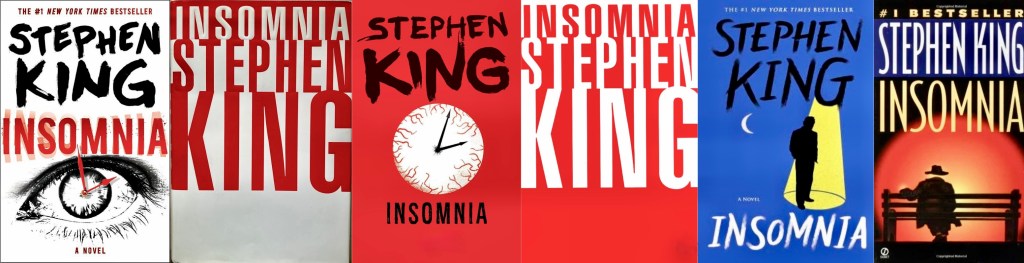
Alright, strap in, this is going to be an interesting one. Our 14th book in my reread project is Insomnia, published in 1994, Stephen King’s 36th book. The 787 page doorstop is dedicated: For Tabby…and for Al Kooper, who knows the playing-field. No fault of mine. So we know who Tabby is by now, but Al Kooper is a musician and songwriter who became friends with King when he joined The Rock Bottom Remainders, a charity supergroup. A band. Stephen King was in a band whose members included but are not limited to – Amy Tan, Dave Barry, Mitch Albom, Barbara Kingsolver and Matt Groening. The Rock Bottom Remainders raised over three million dollars for charity (literary and first-amendment causes) and was founded in ’92. Al Kooper, a real musician, was brought in to ground the group, who Steve himself described as “enthusiastic but sloppy.” Al and Steve became friends and discussed Al’s actual real life insomnia, and so the dedication was born. Steve in this band is giving such 90’s Dad energy that it really makes me squirm.
I have read every single Stephen King book (excluding Other Worlds Than These, which just dropped 10/6/2026 and is on my TBR) and there are very few which I would say I straight up did not like. This book was one of them. I read it in 2005 or so. I had terrible insomnia myself at the time. I was 24. I didn’t like this book, but I thought about it a lot over the years. There were so many things that stood out to me, both then and now. The protagonist is Ralph, he is in his 70s. I love that. I wish there were more books about people in the later (last) years of their lives. Ralph has many friends, retired older folk, many low income, and Ralph himself lives in an apartment across the street from a Big Apple. I love that; a narrative that explores the lives of people who hang out at a picnic table by the airport, buy soup for dinner at the gas station across the street, read poetry, play chess, struggle with loneliness and failing health. Ralph is a widow, his wife dies of cancer in the prologue of the book. Love that. Grief. Death. Beautiful themes to explore. Ralph has a love interest, Lois, who is in her 60s and also a widower. They crush, hard, and I love that! Old people falling in love, being horny, having adventures. All of this feels unique in many ways, and the themes and some of the imagery of this book have stayed with me, powerfully, for decades. However, most of this book does not work. Let’s get into why.
“Old age is an island surrounded by death.”
-Juan Montalvo, “On Beauty”
Ralph is a widow living in Derry, Maine. He develops insomnia which escalates until he is barely sleeping at all. Steve writes about the insomnia with haunting clarity, clearly a city he has explored himself. Ralph tries everything to try and get some sleep, except going to his doctor, a man he mistrusts since he misdiagnosed Ralph’s wife of the cancer that killed her. Ralph begins to hallucinate, seeing auras around people. The auras vary in color and vibrancy, but Ralph notes that a few people have a dark string above their aura, and this signals impending death. One early sleepless morning, while sitting in his dark apartment staring out at the street he sees two small men exit the home of a neighbor who has just died. They are small and wearing smocks and one of them is carrying scissors. These are docs #1 and #2, later named Clotho and Lachesis, and they are agents of purposeful death, benign creatures, not human, who come and cut those black death cords when it is time. Later Ralph meets doc #3, Atropos, who is not benign, but an agent of the random. Atropos sees Ralph, and marks him, not for death, but as a low short-timer (the term for regular folk who have seemingly short lives here) who is meddling where he shouldn’t. So that is one main narrative, and I like a lot of this. The imagery of the scissors and the death cord and the two docs who serve the purpose and the one dirty mean little doc who serves the random are really potent. Ralph is able to see these things because of his insomnia, but it turns out there is more to it than that. Ralph has been drawn into a larger conflict, as an agent, but to whom and for what?
It was about 200 pages into this thing that I started to really struggle with the book and feel adrift in the story, and I think it comes down to how convoluted the plot becomes, because layered onto this we add many more threads. Ed and Helen Deepneau for instance. This young couple is friends of Ralph and his late wife, and Ralph has a strange encounter with Ed in the prologue of the book. Later Ed beats the shit out of his wife and Ralph confronts Ed and realizes that Ed is deranged (or so he frames it at first) and experiencing a psychotic break. Helen leaves Ed (taking their little baby with her) and goes to a women’s shelter. This ties into another layer here, which is the most clunky of all of them to my mind. Derry has a health clinic that performs abortions. It is a lighting rod for controversy in the city. A woman named Susan Day is coming to Derry to speak, and proceeds from her appearance will benefit the clinic. Many people don’t want her to come, including Ed Deepneau who is obsessively focused on dead babies and so called agents of evil in Derry connected to the abortion clinic. Susan is coming to the civic center, and Ed plans to commit violence there. (There is a lot to this story line that we will see again in Never Flinch, my least favorite of the Holly novels (so far – yes I know more are coming, and for the record, my favorite was the second stand alone, Holly, which is fantastic.))
The Derry of the Old Crocks.
The Derry of the Children.
The Derry of the Damned.
So now Lois gets roped into this. Lois was a side character for the a chunk of the book, connected to McGovern, (a baffling other side character, Ralph’s downstairs neighbor who I could not for the life of me figure out. McGovern is gay, a retired professor, argumentative, hard to get along with, who later dies of a heart attack (thanks to doc #3) and nothing he did or said made sense to me.) Lois, Ralph and McGovern hung out together a lot, were friends, but that trio felt so off to me, mostly because McGovern was so confounding. So Lois has insomnia too (and so does Ed Deepneau by the way) and she’s seeing the auras, and Ralph finds her crying on a bench, which begins the longest day ever. Not even kidding it’s the entire middle chunk of this book and it is so damn impenetrable. The book kind of cracks open here and the entire universe of The Dark Tower series gets stuffed in. The writing also becomes very uneven. There are beautiful scenes, horrible dialog, flat characters, confusion, over explanations, repetition, and the plot gets so bogged down in this the reader is moving through gravy. Hundreds of pages of gravy.
Eventually Clotho and Lachesis explain to Ralph and Lois that Ed is going to try and harm Susan Day, and that they need to stop this from happening. That’s explanation number one. At this point Ralph and Lois are fully existing outside of the normal human world. They can see auras, drink from other people’s auras, they are getting younger, and they can move into other dimensions that are adjacent to the real world of Derry but separate, which becomes straight up teleportation as it advances. Ralph and Lois go to the woman’s shelter and stop a bunch of people, including Helen, her baby, and this four year old kid named Pat (put a pin in Pat) from being killed in a literal fire/gun fight. Then Ralph confronts the docs and they get a more nuanced explanation. It’s not about Ed or Susan Day or even all the random folks who might die if this plane hits the civic center, it is about Pat. This four year old artist is the key to Ka, he is on the beam, he is serving the purpose, he transcends, and if this kid dies the tower falls. If you know the Dark Tower Series your mind might be blown, and if you don’t I can’t even imagine what you would make of this damn book. So Ralph and Lois (after a harrowing confrontation with Atropos in his lair under a tree) now have to stop Ed from flying a plane into the civic center. Yes that’s right, these powerful all knowing eternal beings are sending a sleep deprived old geezer to save multiple realms.
The book completely jumps the shark on page 698 and becomes a fever dream. Ralph is on the plane with Ed, but also he is in the not entirely real alternate aura level, and also he then has this encounter with the Crimson King. He accesses all this through a Porta Potty in the park. The Crimson King shows up as Ralph’s mother, floating next to the plane, knitting, and telling Ralph to stop meddling in things. It’s weird for a lot of reasons but the thing that really throws Ralph is the knitting, cause his long dead mother did not knit. His mom is knitting a long red blanket. One might even call it crimson. Then his mom turns into a giant catfish called Queenfish and this is bonkers stuff (I was almost giddy at this point, as I really enjoy when authors swing big, and this was WILD shit). The catfish was pulled from a bad childhood memory of Ralph’s – a huge catfish that he and his brother caught in the Kenduskeag, in the barrens no less, which bit Ralph’s fingers and wouldn’t let go. Now the giant catfish, wearing his mother’s dress and her perfume, and sitting in a rocking chair next to the plane that Ed is flying towards the packed civic center, is telling him in a garbled inhuman voice to stay the hell out of things that don’t concern him. It’s the Crimson King folks. He hijacked Ed years ago to enact this scheme to kill little Pat. He is like ten levels above Clotho and Lachesis, he is an actual immortal. But now Ralph is going to confront him using an earring. And he does, and it works, and he then confronts Ed, and then he teleports out of there. Crisis averted.
Then there is another hundred pages of nonsense. Ralph and Lois get married. Sure. And he experiences some of the happiest days of his life. And then Ralph dies, exchanging his life for Helen’s daughter’s life. It’s complicated, and it was layered into the mess of that “longest day ever” but to boil it down, Ralph sacrifices himself years later so that little 6 year old Natalie can live out her life. The End.
In his memoir, On Writing, published 2000, Steve says that Insomnia and Rose Madder were both heavily outlined and plotted (not his usual style of writing novels) and that they were “stiff and try hard, and lacked the organic flow of his other books”. I do think that this book doesn’t work. But I also am obsessed with this book. It is not good, but it is such a complicated (and to use the word again, convoluted) mash of good, bad, derivative, elevated, flat, rich, and densely layered that you have to respect it for its audacity. I will be thinking of the docs and their scissors and Queenfish for a long, long time. I also wanted to note a few 1990’s nostalgia moments for me: Diet Pepsi is mentioned for the first time (the switch to diet soda was a momentous one for so many families at this time. We know Steve loves Pepsi, but now he is watching his sugars), and in the author blurb on the back jacket it says: He refuses to go into the cellar of his home, having come to believe that a velociraptor is waiting for him under the stairs… a clear sign that Steve saw Jurassic Park (released June of ’93) and was as effected as all of us were by that great film. And I also wanted to mention this weird moment in the book from page 320 where it alludes to the fact that Ralph, as a younger man, was addicted to codeine cough medicine, a “Turpin Hydrate Junkie” which sent me down the weirdest rabbit-hole, and seems to be mentioned for no reason whatsoever. Oh, and (last thing I promise) when Ralph and Lois are talking to Clotho and Lachesis, Ralph asks them about where the souls go after their cord is cut and Lachesis says: [To other worlds than these.] which shook me as I read that line the day that final Talisman book dropped, and I felt like I was on the beam.
Well if you stayed with me this long, my hats off to you, as this was one was a bit of a mess. Up next we have another complicated novel, Rose Madder, which is connected to The Regulators and Desperation AND is part of the abused women era which we will get into more next time. You can find all of my Stephen King Reread Project: HERE.


Pingback: King Reread Project | Thibeautown