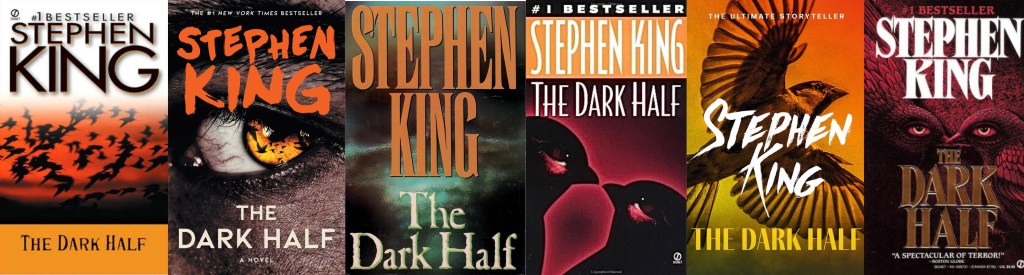
The Dark Half was published in 1989 and is Steve’s 30th book. The book is dedicated to Shirley Sondregger and her husband Pete. Shirley was King’s assistant/office manager at that time. There is also an Author’s Note, “I’m indebted to the late Richard Bachman for his help and inspiration. This novel could not have been written without him.” As we discussed in The Tommyknockers blog King’s drinking and drug use bottomed out during the writing of The Tommyknockers and there was an intervention around that time. The Dark Half is considered a bridge between Steve’s addiction era and his sober era (which starts officially with Needful Things). During this time King was depressed and trying to manage his drug and alcohol use, and learning that he couldn’t. Tabitha had told him he needed to get sober or leave the family; a lot was on the line, but Steve struggled for months to reel it in. He experienced writer’s block during this time, and his pen name, Richard Bachman, was outed. All of these themes will appear in the book, so let’s get into it.
We’ve got Thad Beaumont, a writer, a husband, a father to young twin babies, and a recovering alcoholic (even for Steve, this character is extremely Steve-Y) living in Ludlow, Maine. You’ll remember Ludlow from Pet Semetery. Thad writes literary novels that don’t sell very well, and he teaches at a local college, but Thad also has a pen name, George Stark, and under that name he publishes crime novels that do sell well. But when someone threatens to reveal Beaumont as Stark, Thad decides to beat him to it, reveal the pen name and retire the pen name in one fell swoop. Thad and his wife do a mock funeral photoshoot, in Castle Rock Cemetery (Castle Rock, where the Beaumont’s have a summer home, and where Cujo and The Dead Zone took place) with a tombstone with George Stark’s name on it and everything. But it turns out George Stark does not want to be dead, he wants to write, he wants to live, he wants to be in charge, so he surprises absolutely everyone by taking on something like human form, busting up out of the mock grave that very night, and going on a killing spree, slicing people up with a straight razor (his weapon of choice). George Stark and Thad Beaumont have the same fingerprints, so police begin investigating the murders and Thad is the suspect. Thad’s fingerprints are at the scene but he has solid alibi. It’s confusing.
“He sometimes believed that the compulsion to make fiction was no more than a bulwark against confusion, maybe even insanity. It was a desperate imposition of order by people able to find that precious stuff only in their minds…never in their hearts. Who are you when you write, Thad? Who are you then?“
Thad and his wife immediately suss out that Stark is real (somehow, this made-up pen name has been embodied) and that he is killing people connected to his destruction (Thad’s agent, the man who was trying to blackmail Thad about the pen name, etc) and that George Stark would likely be on his way to Thad next. They believe this, but the local Castle Rock sherif Alan Pangborn is skeptical and urges them to not share this theory with the State Police. Sound advice. Now the police have a watch set on Thad and his family (to protect them, but also to keep a damn eye on Thad who is still under suspicion as being somehow involved) but Stark is calling Thad left and right (on random un-tapped phones outside the Beaumont house), and telling him, – hey Hoss, we are going to write another book. Period. Cause it turns out Stark is actually dying now, falling apart, literally rotting. He will die if he doesn’t write, and he can’t write without Thad. This made me think of the quotes about writers being like sharks, sharks have to keep swimming or they die, and writers must keep writing or they die. Stark is falling apart, dying, even though he isn’t technically alive. But he is a writer and he must write. I can relate, and I’m sure Steve, one of the more prolific writers of our time, can too.
So now we get the chase. Stark is coming, coming for Thad, and his family. No one believes that Stark is real, or if he is, that he is a supernatural entity, tied to Thad’s psyche, and preternaturally adept at killing. There is a large chunk of story here having to do with twins that frankly I didn’t need, I think the book would work without it. Thad had absorbed his twin in utero (Dwight Schrute energy) but when he was an adolescent some cells left over in his brain fired up and started giving him headaches, killer migraines, and the tell for his migraines was the sound of sparrows. He had surgery to remove the growth, (which had an eye-ball!) and went on his way. Now George Stark is the twin that never got to be, come to life. Also Thad has baby twins. But honestly the storyline- man’s pen name comes to life when man attempts too retire pen name, and goes on savage murder spree, implicating man and now hunting man to force him to write more under pen name, is rock solid. The twin thing seemed unnecessary.
Steve’s genius for great story ideas, and instinct for plot and narrative propulsion, is on show here; the story cranks along, building suspense, tight as a rope. Overlaid onto this though is a lot of beauty and some real moments of depth. The imagery of the sparrows is incredibly powerful (and what I remember most about my first read of this, decades ago). Thad begins to see sparrows again (something that happened when he was a kid dealing with his headaches). First just a few, nothing unusual about that, but as Stark begins to close in on him, they increase dramatically. They line rooftops, fill trees, hundreds of them. “Suddenly he could see sparrows everywhere, perched on roofs and trunks and greasy amputated engines. He saw a small trio of birds bathing in a hubcap filled with water. They did not fly away as he approached but stopped what they were doing and watched him with their beady black eyes… The sparrows looked at him from everywhere – a silent convocation of black-brown birds.” By the end, when Stark has forced the family and sherif Pangborn to the Beaumont’s isolated summer house on Castle Lake, the trees and fields are full of them, not hundreds but thousands. But Stark can’t see them. They are Thad’s psychopomps, harbingers of the living dead, conducting souls back and forth from the land of the dead, gathering up lost souls and taking them home. They have come for Stark, but Thad must let Stark go, he must give the signal to the sparrows to take him. Because Thad has not let go of Stark yet. Thad is the reason Stark is here.
“Hadn’t there always been a part of him in love with George Stark’s simple, violent nature?…a man who never looked weak, or silly, a man who would never have to fear the demons locked away in the liquor cabinet? A man with no wife or children to consider, with no loves to bind him or slow him down. A man who had a sharp straight answer to all of life’s more difficult questions?”
In the grappling with Stark we see a man grappling with himself. Can a creative man be a good husband, father, person? What is the distance between who you are when you are writing/creating and who you are waiting in line at the grocery store? And as an addict, who will you be when you put that addiction down? Will you be the same artist? Will you be lesser? Is the booze and the pills part of the magic? If our creative endeavors require a fire, how much of our lives do we allow to get burned up in there? What if the addiction changes you, kills you even, but also fuels your work, gives you the balls to sit down and put it on the page to begin with. Will you find the steel edge without the chaos? Do you even want to try? Are you brave enough to? Thad admires Stark, but he also loves his family. This man, George Stark, is dangerous, but he is brilliantly and entirely free, and he can write like a forest fire, unreserved, and fearless, and powerful. He drinks booze, and smokes cigarettes (things Thad no longer can do). Stark is a high-toned son of a bitch. He is a conduit to Thad’s freedom, but also his destruction. In the end Thad makes his choice.
I read this book one time before, and what I remember most clearly about it is the imagery of the sparrows. But I also realized on this reread that I was lightly confusing it with a few other books by Steve. One is Secret Window, Secret Garden (a novella from 1990’s Four Past Midnight, which (it turns out) is Steve using the themes of The Dark Half and Misery to tell a new story, citation), and The Outsider (2018, the introduction of Holly Gibney) which opens with a man accused of a murder he did not commit but in which DNA, fingerprints, and eyewitness accounts point to him. Also just want to clock that Stephen King loves Pepsi. Many of his characters crack open an ice cold Pepsi (including sober guy, Thad) and I grew up in a Pepsi household, so I feel seen by this.
Well, I really liked this one, a lot of meat on that bone for me. And a very strong end to this era of King’s work. Next we move onto a new season, a new decade (the 90s, my favorite), and Steve’s first steps into sober era, with a real favorite of mine, Needful Things. We’re back in Castle Rock, and we’re back to a big book and big ensemble cast. Cannot wait! You can find all of my King reread project: Here.


Pingback: King Reread Project | Thibeautown