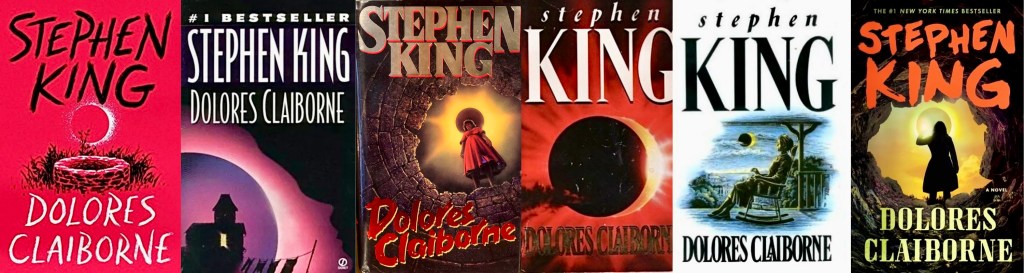
Dolores Claiborne, Steve’s 34th book, was published in 1992. This book is dedicated to Ruth Pillsbury King, Steve’s mom, who died in 1975 (back when King was writing ‘Salem’s Lot) at age 60. Ruth raised her two boys mostly on her own, working hard, and sadly dying young, and Steve has spoken often of his love and admiration for her. This book is, of course, the companion to our last read, Gerald’s Game, and these psychological thrillers (initially conceived as one longer piece called, In the Path of the Eclipse) explore trauma, survival, abuse, sexual violence, and injustice, through the perspectives of two very different women. Both are unique books, especially in the context of the novels we’ve moved through to get here. Our 15th book on the reread roster, let’s go!
One of the things that has always stood out to me in this book is the structure; you have several things going on at once with the narrative. It is a first-person dramatic monologue: Dolores Claiborne, of Little Tall Island, sitting down to tell her story to local police Andy & Frank and stenographer Nancy. But we only hear Dolores’s voice, one narrative deliberately shaped like real speech with digressions, asides, and direct addresses; and though we hear Dolores answer questions, we don’t hear the questions asked. Only Dolores speaks. It is one sustained act of testimony. I love Dolores’ voice itself, her cadence, her humor, and her casual and unique Maine dialect are well writ and endearing, especially to me, a Maine resident who has watched the Maine accent drift into the mist. Through Dolores’s speech we get a sense of her, can feel her edges, worn and sharp, and really embody her, skin to skin.
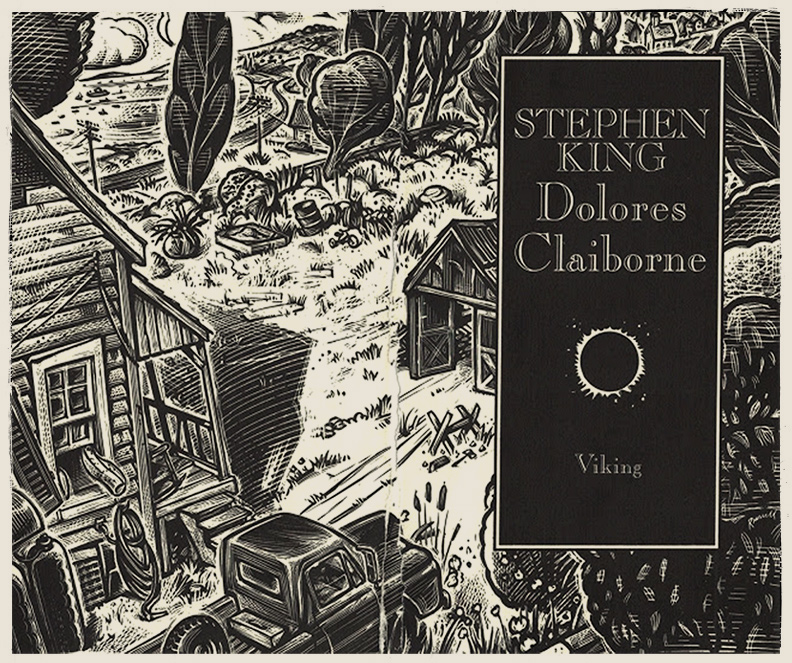
Another stand out in this novel is the setting: Little Tall Island. Though there are short stories set on islands in Maine in Steve’s oeuvre, this the first of the major novels in our reread to take place on one. (“The Reach”, from Steve’s short story collection, Skeleton Crew (1985) is set on an island and is one of my favorite shorts of his ever, gorgeous writing.) Island life is different; it amplifies small-town Maine culture, distills it down to something stronger and more concentrated. I love how real Little Tall Island feels, from the talk of the wind, fog, ferry, Sumer folk, and drama, it paints you onto a hunk of stone in the rough New England seas. Dolores is of the island, in some essential way they are one.
Dolores sits down to tell her story to the police. She is there because her boss, Vera Donovan, has fallen down the stairs and died in her beautiful estate on Little Tall Island. But right away Dolores tells the police (and us) she did not kill Vera. She says, I have killed someone, and let me tell you all about it, twas a long time ago. (I would not advise this. Don’t bring up your dead husband, no one is asking.) She started as a housekeeper to Vera back in the 1950s when her children were young. Dolores was married to Joe St. George and had three kids: Selena, Joe Jr, and Pete. Joe was trash. Dolores worked hard for Vera, who was a mean old rich lady, and established her place there for years until Vera retired to the island and Dolores became her caretaker. These two women knew each other, though never equals, they knew each other intimately. Dolores hated Vera sometimes, but she says again, I did not kill her. But, she says, I did kill Joe, during the ’63 eclipse, and she just spills the whole can of beans on that (again, no one asks about Joe!) beat by beat – the why, when, and how of it. Even tells them that during the eclipse she saw a young girl, struggling with her own troubles, far away but under the dark of the eclipse too.
The details of how she kills her husband are so saturated in the place of Little Tall Island it’s like a rum cake. You’ve got a bizarre full solar eclipse and all that it entails, with Little Tall right in the line of totality (a term all us 2024 solar eclipse observers know well), Dolores has despaired nearly to death about her family, her husband has been molesting their daughter, Selena; he steals money from Dolores (who has no account of her own though she earns more money in a year than Lazy Joe in his side hustle, that mostly involves a beer bottle touching his lip all day), Joe physically and emotionally abuses the entire family, and is just a nightmare (a real Joe Camber type). So Dolores does what she has to do, because “sometimes you have to be a high-riding bitch to survive.” There’s blackberry brambles, and whisky, and an old well with a rotted wooden cover. It’s an Andrew Wyeth painting.
“I have digged a pit for mine enemies, and am fallen into it myself.”
Now Vera knows what Dolores has done. Vera pretty much told her she ought to kill him one night, “Husbands die everyday, Dolores” she said while working her knitting in a rainy window (this book is full of down east vibes, everything desperate and bleak and saturated). And Dolores knows some things Vera has done (though not all the things there are to know, leading to a very surprising and heartbreaking twist at the very end). And Dolores gets away with the murder of Joe, and only Vera knows for sure that it was not an accident.They kept each others secrets, like good friends do. Their relationship is the core of the book and it is an examination of class and love. Life beats these women down, old age takes them under, and as they say on the island: in the end the sea takes everything.
You could drop out the sections of Dolores in Gerald’s Game and the sections of Jessie in Dolores Claiborne, and the books would be stronger. I like the idea of the books being connected by the women, strangers, in the path of this 1963 eclipse, but it is cumbersome on the page. It seems clear that Steve realized this and edited back that connecting thread as much as possible. And it’s fine. But unnecessary. They could still be sister books without mentioning each other, just in that they are published back to back with the same eclipse at the center of the drama.
This book is stark, and oddly elegant, and it really stands out to me in the context of what we’ve read so far. It is a very intimate book. Gerald’s Game and Dolores Claiborne are both taut, unique, and well written psychological novels that do the heavy lifting, and are provocative as hell. They both feel to me like literary fiction, outside of the supernatural genre, just profoundly good. It feels like a leveling up. Steve didn’t need the booze and pills to do the writing, the magic was in him all along. And he’s exploring gender and class in ways that seem much deeper than before, he’s challenging his own viewpoints, he’s growing wiser, and it shows in the writing. I loved it the first time I read it and I love it even more now. One of his absolute best
I don’t want to get anyone too excited here but the next two reads are: Insomnia and Rose Madder. Two damn doorstops, and two extremely divisive novels in the King Universe; people tend to feel strongly about them, one way or another. I have my thoughts. And you can come on back and hear em. Soon. Happy Autumn!
Find all of my Stephen King Reread Project: HERE.


Pingback: King Reread Project | Thibeautown