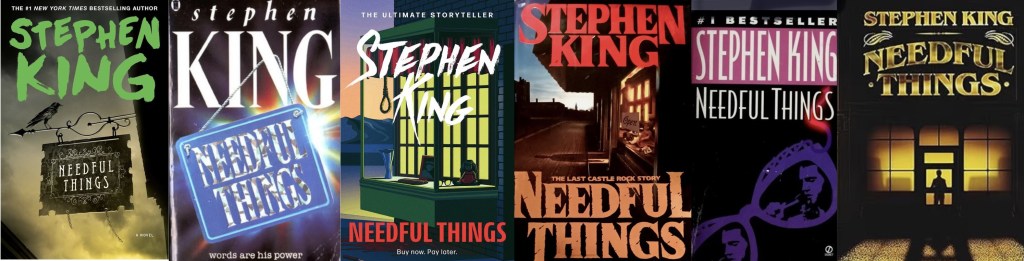
Welcome back, and we’re diving in with another doorstop, 690 pages back in the Rock, with 1991’s Needful Things. This book is dedicated to Chris Lavin, a friend and neighbor of the King’s. The copy I have from my local library (shout out GPL) is the Viking hardcover and contains some really striking art from Canadian born artist Bill Russell. I’ll attach some of the work below, they look like woodcuts, or linocuts, but they are actually scratchboard illustrations, which Russell was known for. Although Russell was not primarily a book illustrator he did three consecutive novels for King (we’re entering the Russell era, as well as the sober era, of King’s work) so we’ll be seeing his work in Gerald’s Game and Dolores Claiborne. I love the art in this book, it has a folkloric and stark feel that suits the themes perfectly. You can find out more about Bill Russell here: https://billrussellfineart.com. This reread was only my second, as I last read this book when I was 16, so let’s get into it.
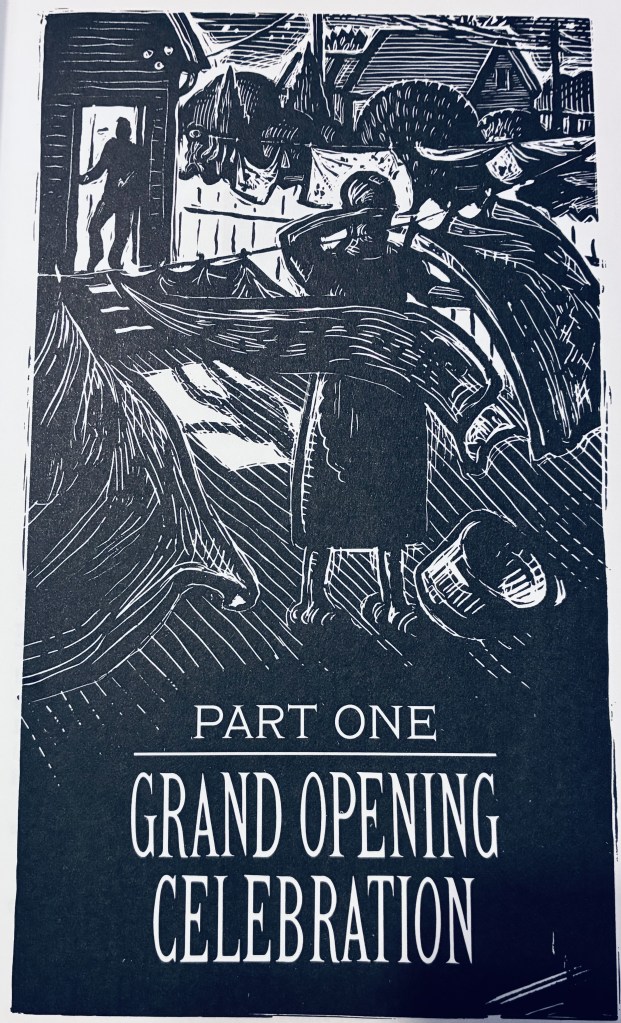
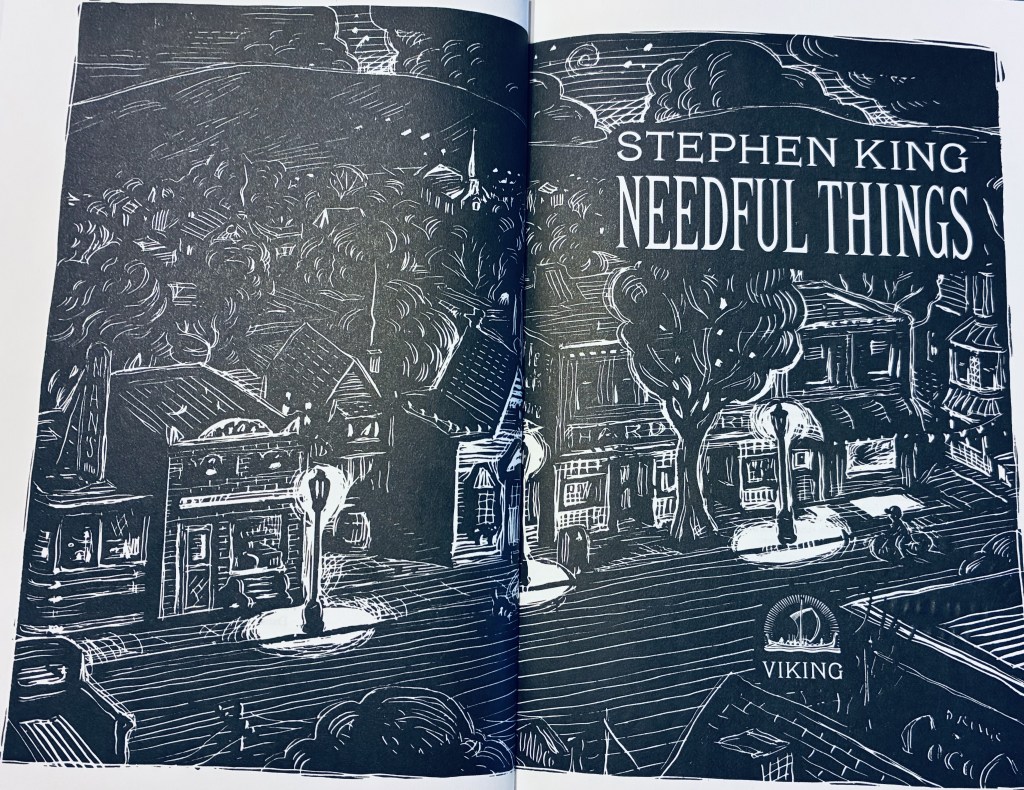
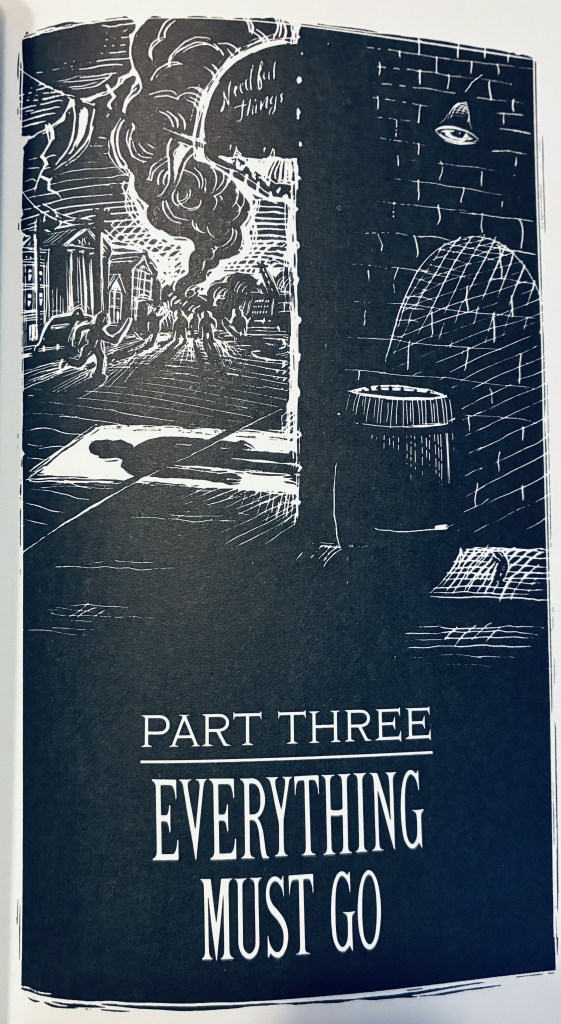
Click on image to see slideshow.
In this novel we roll right from the Dark Half timeline into this new Castle Rock story (and it is advertised as the final Castle Rock story, which turned out to be spectacularly untrue (as Maury would say – that was a lie) because despite almost burning the place to the ground, King will absolutely be back.) A new store is opening in town called Needful Things. And our proprietor is a man named Leland Gaunt. We find Sheriff Alan Pangborn, who is now a widow; his wife and young son killed in a car accident, and his older son away at school, Pangborn is anchor-less, and grieving. One thing I love is that it is mentioned here that in the months after the sparrows took ol’ George Stark away, Thad Beaumont would call Sheriff Pangborn often, very drunk, and that Thad’s wife took the damn twins and left him. Which really made me laugh, because it plants the seed of – what the hell was it all for?! Thad lost his family, his beautiful lake house burned to the ground, his ability to write probably left with George; Thad is a shell of a man, sinking into the dark seas of alcoholism, perhaps to never see the light again, and drunk calling the Sheriff on the regular. Regardless, Pangborn is our main protagonist here.
Pangborn is dating Polly Chalmers. Polly is a confounding person to me. She is known as the town’s most eccentric character (which even in the confines of this story is not true). She was born and raised in Castle Rock but committed the sin of leaving. She ran off to San Francisco, pregnant, had a baby boy, then washed back up on the shores of the Rock sans any baby. Now she is 40 and has a sewing store and a severe case of arthritis in her hands that causes her pain and disability, and she refuses to talk about her past. So she is a tragic figure, and an interesting one to put as the love interest of the Sheriff, frankly. But we’ll get into that later.
There are a whole slew of other characters, but I’ll just highlight a few, as this book is full to the brim, which is enjoyable when reading but a bit much in an overview. Brian Rusk is an 11-year old boy (and he was what I remembered most from my first read, though I did not connect with him as strongly this time.) who loves baseball cards. Norris Ridgewick is a deputy who loves fishing. Danforth “Buster” Keaton is a town selectman and a gambling addict who is embezzling funds from the town and has a real case of fragile masculinity; he is deeply insecure, violent, and is a problem even before he buys anything from the store. Netitia “Nettie” Cobb is Polly’s best friend and house cleaner (which gave me pause. I am a house cleaner, and the idea that you would be close friends with someone you clean for and that Polly had “saved” Nettie by hiring her and befriending her didn’t sit right with me, the dynamics of that friendship are out of whack.) who has a dark past. John “Ace” Merrill is the town’s bad boy (although he is aging out of the role into more of a general criminal, and is described at one point as a “geriatric biker” which really made me laugh, we’ve met him before in several short stories.) and a drug addict and an enemy of the Sheriff. Now all of these people go into Needful Things, the store, and buy something. All but the Sheriff.
The best thing about this book is Leland Gaunt, owner and purveyor of Needful Things. He is a creep. And I love him, gleefully, he might be my favorite King villain that we’ve encountered so far. Leland is queer coded. He shape shifts, his eyes changing color, his manner turns on a dime, and he is the consummate salesman. He has a capacity to put people at ease when they first enter his store, to soothe them, make them comfortable, make them feel seen, and then flip the switch and snare them (mostly through hypnosis). He is a damn mess maker, and I love a messy queen. As Brian Rusk says to his little brother as warning, Mr. Gaunt is not really a man at all. He has been selling wares and gathering payment for a very long time and he is good at it, masterful even, and no one in the town is a match for him.
“He let her scrabble for a few moments, his face amused, and then he slapped her hands away. “Forget it,” he said. “Oral sex gives me amnesia.”” – pg. 114, the best Gaunt quote in the book
Leland sells antiques and bric-a-brac to all the townspeople; rare baseball cards, fishing reels, lamps, games, a fox tail, several items of Elvis Presley memorabilia (the disdain Leland has for the Elvis women is THICK). He has exactly what they want at unbelievably low prices. But each sale comes with a clause, a favor that the purchaser must do before the sale is final. Gaunt calls these practical jokes – leave a note somewhere, slash a tire, kill a dog, you know, just little jokes. And of course each little joke sets off a series of consequences, amplifying existing tensions in the town, and setting off ripple effects that lead to escalating violence. And it doesn’t take much to tip these people over into full blown violent murder, and that is kind of the point. As with many of King’s books we find at the heart of it that the monsters don’t need to do much, that the evil is already there, in the town, in the people, before Gaunt even sets up shop, he is just gently blowing on existing flames. Leland plants his little bombs, with each sale, and eventually plants real bombs and starts straight up selling guns from a table in the back alley (again, really funny). The people who buy things from his store become obsessed with the objects, and paranoid about the objects being taken from them. This myopic focus keeps everyone’s head down (except the Sheriff) as the town unravels.
I did not enjoy this book as much as I thought I was going to. I think the weak points here were: Sheriff Alan Pangborn and 690 pages (too damn long). The Sheriff was not a character I connected with. I think he was written a bit too pure for me. I like something a little more complex (although the other characters in the town, who buy goods, and get all tangled up in their own mucky psyches, do scratch that itch). I couldn’t really crack the Alan/Polly relationship either, it didn’t really work for me. And maybe that was on purpose, as Polly is kind of impossible. She is walled off, she has those stiff claw like hands held out in front of her for most of the book, in pain, popping pills, but also sort of painting herself as a saint (the whole Nettie thing). I didn’t like Polly. She buys a necklace from Gaunt, which cures her arthritis. This was also complicated for me, because she is the only one in the town who has a very compelling reason to hold on so tight to her purchase. The miracle cure completely transforms her life, for the better, while most other people in the town are using their purchases to have pretend sex with Elvis, or win at the track, or hang out in a weird bible fantasy (there is an entire storyline of the Baptists and the Catholics in town that I do not have the energy for, but one thing Gaunt sells is a piece of petrified wood from Noah’s ark.) Polly is better off with her necklace. So when she casts it aside and fights the creature that emerges from inside it (a spider that eats her pain, love that, love it) I was torn. She felt like a martyr, forced to do penance for…being a slut and leaving town to explore other ways of life? Didn’t love that.
The other thing about the Sheriff is “the magic.” Sheriff Pangborn loves to sidle up to someone (and he moves like a cat according to all descriptions, having preternatural balance and speed) and do some non-consensual close up magic. This is unacceptable. In fact, he uses close up magic on his girlfriend, Polly, to get in her pants, and it leads to mind-blowing good sex (in which her claw hands are held to the side the whole time, I guess? Unclear.) I cannot get behind any of this. And, of course, this book is too long. The first half is great, but the second half is bloated. We have dozens of lines in the water, and we keep toggling, endlessly, between and betwixt, but things don’t move along at the clip they need to, and by the time Ace rolls into town (which is late) I was struggling to stay engaged. Also a bit meh on the ending, as King once again wipes an entire town off the map to wrap things up. And Leland just leaves town (I did love the imagery here, he fully turns into a demon, and his car, a Tornado, turns into a horse drawn carriage with CAVEAT EMPTOR – let the buyer beware – emblazoned on it.) only without his suitcase of souls. Cause the Sheriff uses his magic tricks to put one over on the actual Devil, and grab the valise of souls from Leland. Hard to swallow, frankly. I guess Pangborn was channeling some kind of white magic, but I was not moved by this. I did like this book, to be clear, but I expected to love it (loved it the first time), and it was too long to love. So many great elements but too much fat. A leaner Needful Things might have been a favorite. Not to body shame novels, I love a thick novel if it is engaging, but the density here took away from the clarity, rather than sharpening it.
We are tackling one of my least favorite King novels next, Gerald’s Game, which I have read one time before, in my early 20’s. Will I like it better? Worse? Check in a few weeks to find out. You can find all of my King Reread Project: here.


Pingback: King Reread Project | Thibeautown