
Published in 1992, Gerald’s Game is King’s 33rd book, and a tremendous departure from everything we’ve read so far. The book is dedicated, with love and admiration, to Tabitha Spruce King and her five sisters: Margaret Spruce Morehouse, Anne Spruce Labree, Catherine Spruce Graves, Stephanie Spruce Leonard, and Marcella Spruce. This is a particularly apt dedication given that this is an extremely character driven psychological novel that requires the reader to spend the entirety of the book inside the consciousness of a woman, and deals entirely in male power, sexual coercion, childhood sexual abuse, marriage, fear, and survival as experienced by a woman. King has admitted that in his early work he struggled to write female characters. But as his craft improved and his relationship with his “ideal reader,” his wife Tabitha, deepened through struggle, he delved deeper into female driven stories, with greater and greater success. We get more incredible art from Bill Russell. And we get a map of the 1963 total solar eclipse path of totality. The ’63 eclipse is what ties this book to Dolores Claiborne (our next book). These are sister novels, and we’ll get into their connection as we go.
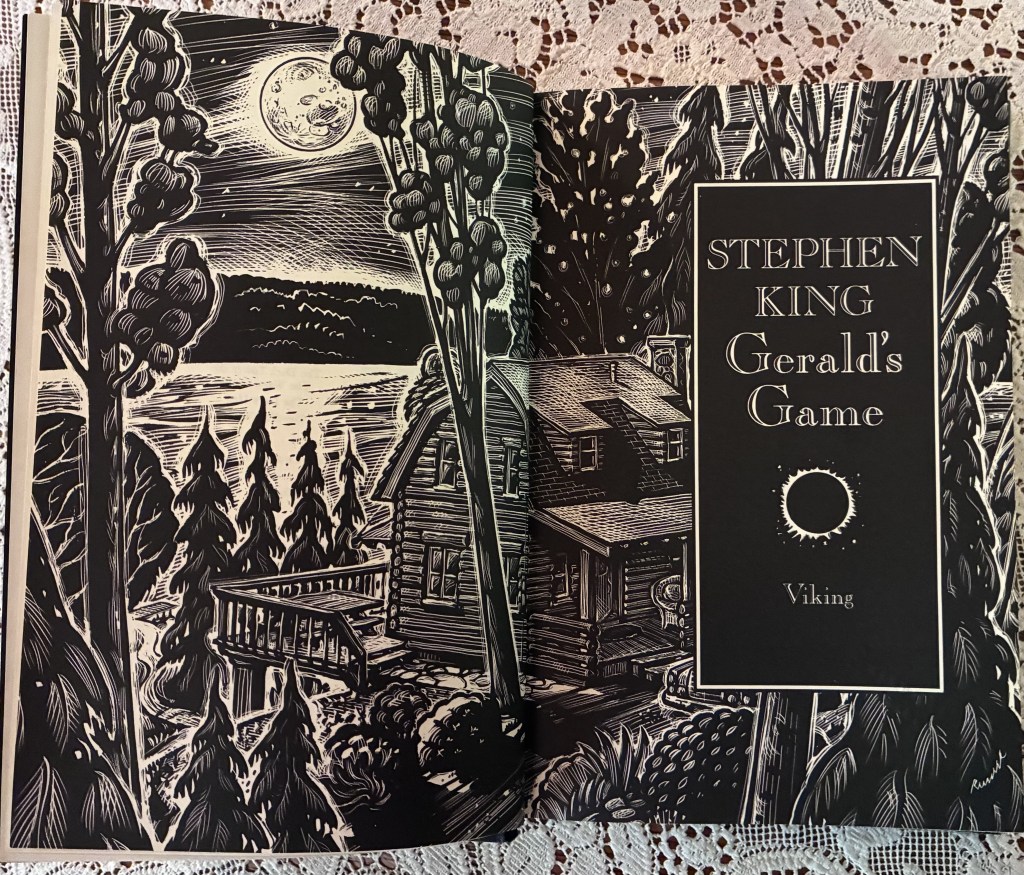
Jessie and Gerald Burlingame, married 17 years, have gone to their lake house in western Maine for a romantic weekend during the off season, in mid-October. We drop into this story to find Jessie handcuffed to the couples bed, and Gerald placing the keys to the handcuffs on the bureau across the room. This is Gerald’s new obsession, bondage, and Jessie no longer enjoys the idea, especially since Gerald bought the real metal police issue cuffs. She is asking for Gerald to unlock the cuffs and forget about the afternoon romp on the first page. In fact she asks him to unlock the cuffs three distinct times, stating more clearly each time that she is serious about no longer wanting to have sex with him. But Gerald pretends not to understand, pretends this is part of the game, and continues to advance on her until he is atop her, and she realizes he will not heed her request to stop. So she kicks him, hard, in the chest and balls. He gasps, turns purple and falls off the bed, dead of a heart-attack, leaving Jessie chained to the bed, alone in the house, 5 miles down a deserted camp road. She can’t get to the phone or the keys. She is in trouble. If Misery is two people alone in a house; this book is one woman chained to a bed.
As I stated last blog, this is a book I have read one time before, in high school. I remember struggling with this and I can see why. I wasn’t ready to handle this book, which is a challenging and arduous read. This is a distinct departure for King in many ways (in regards to what we have read so far.) This book is saturated in violence, sexual violence, interiority; and layers time and consciousness in profound new ways (that King handles masterfully).The explicit sexual content is noteworthy, and divergent from previous handlings of sex. This book is also extremely terrifying. I found it a very trying read, again, but my impressions here are different. I was 14 when I last read this book. I am now 45. My understanding of Jessie, a married middle aged woman, has shifted dramatically, she is my contemporary now, and her experiences around sex, men, power, and social hierarchies are all deeply familiar to me in ways they could not have been when I was 14 and had little experience with any of those things.
We are in the room, on the bed, for almost all of the book, but we are also in Jessie’s head, and King has given us many different aspects of Jessie’s personality, voices, that interact in her psyche. Ruth is one voice, Jessie’s old college roommate who has left Jessie’s life in reality, but whose strong, feminist, take no bullshit voice has become part of her inner personality. Goodwife Burlingame is another voice, a keep sweet, do as you’re told, don’t break any rules, endlessly critical mother like figure. Punkin is another voice, Jessie’s child id. These voices argue, and interact, with Jessie and with each other as Jessie navigates the horrific situation she finds herself in. Jessie also slips in and out of dreams, nightmares, and memories while chained to the bed. All this toggling and all these voices could sound confusing, but there was not one moment when I lost the thread here, because King has always been good at this, layering consciousness, and showing us interiority of his characters in real time. I loved the cast of characters. The main timeline outside of Jessie tied to the bed is the summer of 1963, on another lake, Dark Score Lake, with her family, when Jessie was 11. It was during this ’63 eclipse that something bad happened, between Jessie and her Dad. Jessie keeps getting pulled into this past timeline, in dream and memory, though she does not want to remember.
Jessie and Gerald have come up to Kashwakamak Lake in mid October, their neighbors are all gone south for the year, and the camps around them are closed for the season. The desolate and sorrowful autumn vibes here were palpable, and exquisitely rendered. It is currently late September in Maine (for me, the reader) and I can feel that sadness (and fear, fear of the coming winter, a season with teeth) in the crisp clear air. Jessie lays in the bed, her husband dead on the floor. She is naked, other than her panties, and she is chained to the head board. There is a loon out on the lake calling (haunting), and in the distance someone runs a chainsaw, and a dog barks. She is at least five miles from the nearest human. And before she can even wrap her mind around what a mess she is in the stray dog shows up, slipping in the back door which is banging in the breeze (for the entirety of this book so get ready for it,) and slinks into the bedroom. Jessie yells at the dog, but it assesses her as harmless (if loud) and goes and rips some flesh off of the no doubt still warm Gerald. The dog is starving, and has a sad backstory, but you end up hating the dog, as it loudly eats Gerald. Then the dog leaves the room with a hunk of Gerald’s face. This is day one, and Jessie falls asleep, a chilly stress nap if ever there was one.
When Jessie wakes from a dream about the eclipse, without giving the reader the “what” of that terrible day, we get the real terror of this book, a universal and deep horror – realizing someone is standing in your dark bedroom when you awaken in the night. Jessie sees a man standing in the shadows in the corner of the room. He is tall, with long face and limbs, and he has a wicker box at his feet, which he opens and shows to Jessie. Inside are bones and jewels and he stirs them with his long, long pale fingers. He stares at her, he smiles. It is deeply unsettling, and one of the scarier scenes in any book.
The claustrophobia of this book is real, and it makes it an uncomfortable read, broken up only by moments of extreme fear, sadness, and horror. Jessie spends an interminable amount of time trying to get her hands on a glass of water sitting on a shelf behind the bed. She can’t get out of the cuffs, or off the bed, and she can’t reach anything of value. The position she is in doesn’t allow her to properly lay down or take weight off her shoulders, and she is soon wracked with pain, like a crucified prisoner. Her mind is also breaking – her terror at being trapped, the idea that she might die here, the memories swamping her about her father (which she has suppressed her entire life), the sights and sounds of the dog eating Gerald, and the thought that when nightfalls the man (she calls him the space cowboy) will be back – she knows he will be back, for he is clearly death, and he is clearly coming for her – all edge her towards madness, and as the reader you are right there with her.
“I don’t think you’re anyone! I think you’re only made of moonlight!”
I knew what was coming and I dreaded it with fresh vigor as I moved towards the denouement of this story. We finally go through the entire memory of the eclipse, a complicated story of childhood sexual abuse by her father that does a beautiful job laying out the tangled nest of emotions Jessie is forced to sift through – the jealousy and hatred her mother had for her as she reached adolescence, the love she felt for her father, and the special bond they had leading up to the eclipse, the strangeness of that day, of her changing body, and the changing dynamics in her family; and the incident itself, which occurred during the totality, when the day went dark, the owls and crickets began to call, as Jessie sat on her Dad’s lap looking up at the dark orb that was the sun through sheets of smoked glass. The assault changes her relationship with her father forever, ruining it basically, and her father manipulates 11 year old Jessie into taking the blame and keeping the secret, forever. And during Jessie’s reliving of this trauma she remembers a vision she had after the eclipse, of a woman, also experiencing the eclipse, and looking down a well. It’s brief, and it is the tie to Dolores Claiborne. Jessie emerges from this real remembering done in. It’s dusk. The space cowboy will come back, she has to get free, and so she does the unthinkable.
I have a reputation for loving ugly art, difficult stories, and devastating books and movies. I have always been drawn to darkness. It surprised me how affected I was by the de-gloving scene in this book. I actually had to do breathing exercises while reading the few pages where Jessie breaks the empty water glass and uses the sharp edge to cut around her entire wrist, then yanks her hand out of the cuff, pulling off most of her skin in the process. It is harrowing. I found myself murmuring, these are just words on a page, this isn’t real, as I struggled through it. Jessie is now weak, and has to get to the key (she is still attached to the bed and heavily bleeding), and then get to the phone. It is getting dark. She is fighting to remain conscious. Then the phone is dead. Then she hears the stray dog howling and she knows the man is back. Horror. This is very drawn out, but, it works, and I loved it. We end with Jessie confronting the man, trying to bribe him with her rings (he seems to like to collect them, so it’s a smart move) and running out into the night, to the Mercedes, which won’t start (straight up horror movie canon). Finally it does start, and she drives towards the main road, only to look in the rearview mirror and see the space cowboy smiling at her in the back seat, and he leans forward and whispers in her ear. Bone chilling. Fade to black.
There is a part of me that wishes the book ended there. It could. But we get a final act, which reminded me a bit of the Misery final chapter. The after. Jessie is back in Portland, months have passed, it’s winter. She was found that day in her car, nearly dead, and alone (no space cowboy). She deals with the cops, and a lawyer (a friend of Gerald’s from his firm) helps her navigate the investigation. She gets a lot of money from insurance. She has multiple skin graphs on the hand. She has an Irish cleaning lady (bit close to home for me) who looks after her (but she laments that this woman is only “doing her job” and doesn’t really care for her even though she is the one companion in her life now. I have thoughts on this. For another time.) And it is here in the after that we get into the space cowboy. She never told the cops about him, because she sort thinks he wasn’t a real man, and the cops find no evidence of anyone else in the house. But then Jessie starts to follow a news story, and it turns out that the man was real, a man named Raymond Andrew Joubert, who robbed graves for years, alluded the police, but is caught a few months after Jessie’s ordeal. Part of me didn’t want this, didn’t want the clarity, or even like the storyline of him being a ghoulish man with a streak of necrophilia and kleptomania. I didn’t want him to be a real man, honestly. BUT. But, there is a scene at the very end of the book that kind of made me except the whole final act thing (did any of you see Nightmare Alley? I felt similarly about that movie, in that the very end of that film made the entire rest of it work, and that it sort of slags along until that final moment, that tightens the whole thing up to a singing, clear chord.) Jessie goes to the court to see this man, this Raymond Andrew Joubert, get sentenced, and she wears a veil, and she goes up to him, as close as she can get, and hisses at him till he turns and looks at her, and she lifts the veil, and he recognizes her, and then does something so scary, and so perfect, mocking her to utter perfection in the most haunting way, and I was like; ok, that was worth it, I think.
I liked this book a lot. The character of Jessie Burlingame, along with Bobbi Anderson and Annie Wilkes, set the precedent moving forward for King’s strong female characters. There are many novels that will come later that center women’s stories, and look at violence, especially sexual violence at the hands of men claiming to love the woman they are abusing. This book strips away all of the tools King had used in the past, and shows him to be a skilled writer who can take the reader on a really difficult psychological journey centered on women’s experience, it is a real leveling up of King as an artist.
Up next we have Dolores Claiborne which I have read 3 times before, and which I love. So excited to get into this, and we’ll have a little more with Jessie here as well, because they are sister books, wed by an eclipse in 1963. You can find all of my King Reread Project: here.


Pingback: King Reread Project | Thibeautown