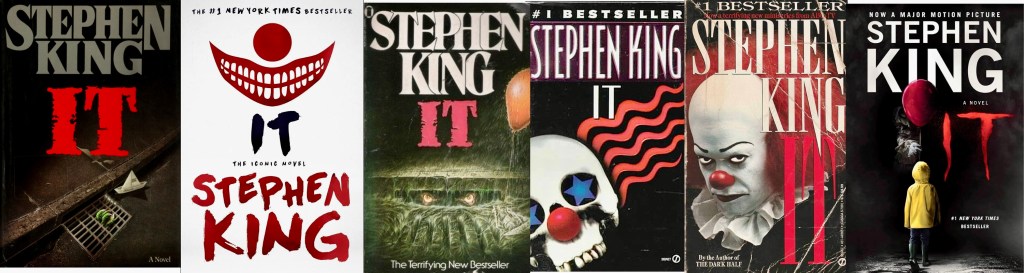
It was published in 1986 and is Stephen King’s 22nd book. A note at the end says: This book was begun in Bangor, Maine, on September 9th, 1981, and completed on December 28th, 1985. It won the British Fantasy Award in 1987, and led to multiple adaptations including the 1990 miniseries (with Tim Curry as Pennywise), a two-part film in 2017 (with Bill Skarsgard as Pennywise), and a 2025 television series, It: Welcome to Derry. The book has sold over 2 million copies, and Pennywise has become one of the most iconic villains in popular culture. The page count on this doorstop is 1,130 pages and the audio-book runs 45 hours (it is just a few dozen pages shorter than The Stand). The book dedication reads: “This book is gratefully dedicated to my children. My mother and my wife taught me how to be a man. My children taught me how to be free. Naomi Rachel King, at fourteen; Joseph Hillstrom King, at twelve; Owen Philip King, at seven. Kids, fiction is the truth inside the lie, and the truth of this fiction is simple enough: the magic exists. S.K.” It is a beautiful and apt dedication for a book that explores childhood with incredible honesty, and profound depth. I’ll tip my hand right now and say that I love this book, and consider it a marvel of modern literature. It was fascinating to reread as it is so dense and teeming, and it surprised and challenged me at every turn; the experience of tackling it again, and doing a deep reading, was breathtaking, arduous, and profoundly moving.
“The terror, which would not end for another twenty-eight years – if it ever did end – began, so far as I know or can tell, with a boat made from a sheet of newspaper flowing down a gutter swollen with rain.”
This book has three distinct narratives, and seven major characters, with dozens of minor players. We have the 1957/58 Losers Club – kid narrative, which covers the spree of child murders in Derry, Maine, and the coming together of the seven kids to form the Losers Club, and the eventual confrontation/meeting of It in the sewers in the summer of ’58; and the 1984/85 – adult narrative, with the spree of murders signaling Its return, reconvening of the Losers Club Adults, their journeys back to Derry, the remembering, and the second confrontation in the sewer in ’85, which coincides with a storm/event that destroys most of the city; and the Derry Interludes- Mike’s journal recounting the history of Derry/It, which covers events from the early 1700s through the current timeline, staggered in 27-30 year increments.
The ’58 Losers Club is made up of seven children: Bill Denbrough, “stuttering Bill” whose six year old brother George is murdered by Pennywise in the opening scene (one of the greatest opening chapters to any book I’ve read); Beverly Marsh, “Bevvie”whose abusive father dominates her life; Ben Hanscomb, “Haystack” who is the fat kid; Eddie Kaspbrack, “Eds” whose asthma and overbearing (emotionally abusive) mother dominates his life; Richie Tozier, “Trashmouth” known for his voices/impressions (which are annoying and often racist) also glasses; Stanley Uris, “Stan the man” the Jewish kid, meticulous, and a lover of logic and ornithology; Michael Hanlon (my favorite character), “Mike” is the black kid.
The ’85 Losers Club is made up of the six remaining adults who make it back: Bill is now an author and married to an actress named Audra, Beverly is a fashion designer married to an abusive man very much like her father, Ben has lost the weight (we’ll get into that) and is a famous architect, Eddie is a successful limousine company owner/driver who is married to a women hauntingly similar to his mother, Richie is a voice actor and famous DJ, and Mike (who is the only one to never leave Derry) is the town librarian and historian and keeper of all the memories. Mike makes the calls to tell the far flung Losers Club that It is back and the time has come for them to make good on their promise to return. This call causes Stanley (accountant) to commit suicide.
The Derry Interludes cover many, many events in Derry linked to It, and to the ebb and flow of evil, trauma, and forgetting that seem inherent in the soil of the town. The 1905 ax massacre by Claude Heroux in The Silver Dollar, the 1906 Kitchener Iron Works explosion in which dozens of children were killed during an easter egg hunt, the 1929 Bradley Gang execution where townsfolk lured a criminal gang downtown and filled them full of lead, the 1962 Black Spot fire (and guess who is there and survives – our old friend Dick Hallorann!) where a hate crime is committed in an African American nightclub and haven for POC military, and the murder of Adrian Melon who was beaten and thrown into the canal where he died (and was eaten by It) because he was a gay man. The tone and tenor of these is that evil happens in Derry, witnessed or participated in by large numbers of the city residents, and then forgotten or covered up. It is always there, in one form or another. There is no justice, there is no processing, the town simply moves forward, allowing It to continue its cycle of violence, rest, awakening, etc.
We also have the bullies: Henry Bowers, Belch Huggins, Victor Criss, and Patrick Hockstetter. The Bowers gang looms large in the 57/58 timeline, terrorizing all the members of the Losers Club in turn and as a unit. Henry is the leader, and we learn that his father is insane, abusive, and the creator of the monster that is Henry. The Bowers family farm is just down the road from the Hanlon (Mike’s family) farm. The Hanlon’s are one of the very few black families int he town. The Bowers are deeply and openly racist, and commit many acts of violence against the Hanlon’s (including poisoning Mike’s dog). Belch and Victor are vague sidekicks to Henry, but Patrick is a named sociopath who kills animals for fun by locking them in a click handle refrigerator (which any Gen Xer lives in abject fear of getting locked in) at the town dump. Interestingly It kills Patrick, Victor, and Belch in the ’58 timeline, but Henry returns in ’85, escaping from the Juniper Hill Asylum (an escape aided by a ’58 Plymouth Fury that seems pretty familiar), a psychiatric hospital that Henry has been locked in since ’58 for killing his father and having a psychotic break (brought on in part by It). Henry is a tragic figure.
What is It? An interesting contradiction in the book is that It, Pennywise, the dancing clown (who we meet in the opening chapter as a clown luring Georgie into a sewer grate), is alluded to, at times, to be Robert “Bob” Gray, a man from a traveling carnival, who arrives in town in the early 1900s, and also an ancient “alien” who landed in Derry long before there was a town or people. It is a shapeshifter, taking the form of what its viewer fears most. So Bill sees his dead brother Georgie, Beverly sees blood coming out of the drains in her apartment bathroom (a home that is not a safe place for her, ever), Ben sees a mummy, Eddie sees a leper, Richie sees a werewolf, Stan sees the drowned bodies of people who died in an accident at the Standpipe, and Mike sees a massive bird. Pennywise the clown is perhaps Its favorite form. Eventually we see It down in its lair, in the sewer where it looks something like a spider, but also behind the spider there are the deadlights. In true Lovecraftian ethos It is beyond the human mind’s comprehension, and therefore you can never really see It without going mad, and your mind will always cobble together some kind of alternate form to protect itself from annihilation. We are also told that whatever form It takes it is held to the laws of that form, so It can be hurt or even killed in its various forms. I’d say the basics are – It came from far away, long ago, and found a home in Derry due to its freedom to kill (feed) on the rich food of fear, and to retreat and rest in the elaborate and insane sewers that run under the city. Also the turtle is down there in the sewers. You know, the turtle that threw up the Universe. Keep up.
“Something new had happened.
For the first time in forever, something new.
…It had discovered a depth of imagination here that was almost new, and almost of concern. This quality of imagination made the food very rich. Its teeth rent flesh gone stiff with exotic terrors, and voluptuous fears: they dreamed of night beasts and moving muds; against their will they contemplated endless gulphs.”
This is a dense novel, and a challenging read. It has weight. The interweaving of the three narratives and the inclusions of seven major characters with so many important side characters means you are, as a reader, given a lot to deal with on the page. There is a tremendous amount of violence, most of it against children. There is animal cruelty. There are so many monsters, both real and imagined. Beverly’s adult narrative has her in the thick of an extremely abusive relationship with her husband Tom Rogan. Tom reminds me A LOT of the husband in Rose Madder, the abusive, psychotic police officer Norman Daniels who hunts his ex-wife Rose with unrelenting and obsessive violence. The scene in Bevvie’s kid narrative where her father wants to check her to see if she is “intact”, and chases her through the streets in a blind rage is so terrifying and maybe the realest terror in the book. Beverly is not being chased by a movie monster, this is her father, a man who says in a cold calm voice, I worry about you Bevvie, I worry a lot, as he beats her. Henry Bowers is increasingly dangerous, carving letters into people’s stomachs, breaking arms, and eventually killing his father in cold blood. The kkk sets a bar on fire with people inside, a gay man is beaten and thrown into a canal, murdered. It is a lot. And the lore of It is a lot too. The metaphysics of It and the Turtle and the Deadlights…dense and at times complicated! But throughout the entirety of this book I felt deeply IN IT, I was inside the universe of It, I was consumed. I wouldn’t change a thing.
There is a lot of what I’ve come to think of as Steve’s boomer take on fatness in It. There is a whole section where we follow Ben Hanscomb into his teen years at East Side High School, where he is mocked and abused by his peers, and in a scene that is deeply horrifying his coach grabs his man boobs and squeezes them painfully, telling him to shut up (Ben is sobbing after being assaulted by his classmates in the locker room) and that Ben disgusts him. The gym teacher is a villainous character but the incident leads to Ben starving himself to loose the weight and get thin. This weight loss ultimately leads to him winning the love of his life (Bev). Complicated. There is more weird ugly fat shaming around Eddie’s mom Sonia and wife Myra (both very overweight and horrible lazy female characters, overbearing mother/wife, a trope of fat people being corrupt, selfish, greedy, mentally ill and villains.) It isn’t that these people are fat, but how they are presented and written about that bothers me. On that note there is some stuff with Beverly that also felt gritty to me. The way her body is written about is very different than how Steve writes about the bodies of the other six male characters. Beverly is a great character, and well written, but it did stand out to me that she is sexualized in some scenes needlessly. And I’m not talking about the orgy in the sewer, I actually think Steve is on solid ground there, that whole sequence works for me and is vital to the book, a ritual to save them, get them out of the sewers, and a rite of passage into adulthood. I loved the writing there, to be honest. The imagery of the birds flocking and filling the trees, the sky. Gorgeous.
My love for this books lies in its honesty. Childhood is sometimes idealized and romanticized, but my memories of childhood are steeped in fear and powerlessness. Children are vulnerable, and adults, though supposedly protectors, so often abuse and betray them. Kids aren’t wholly in the world yet, their minds and hearts contain mysteries, they have one foot in something else, something deeper, something more magical, something from before, but also something dangerous. And on the other side, once we become adults, once we leave childhood behind, that door closes forever. You will never be a kid again. You will never have friends like the ones you had when you were 12 (the perfect closing line from King’s The Body.) Once you leave home you famously can’t go back again, and you’ll dream forever of that place, a place that disappeared the moment you set foot down the road to adulthood (probably at a run, desperate to get away). King writes kids better than most. He clearly has not forgotten what it feels like to be a child. And that is a gift. He is good at scaring us because he knows that our fears are deep in our psyches, writ when we are just big eyes staring over the covers into the dark, and everything that comes after springs from those places. At the end of It the remaining five move on, and the forgetting begins again. And it seems clear to me that It is not dead. Ben couldn’t have gotten every egg. It is in the soil, in the bedrock, and in the chasms within us. Hopefully when we have to face It we will have the power of love, friendship, loyalty, and memory to buoy us, give us strength, and see us through.
I really appreciate ya’ll going on this journey with me, it has been such a privilege to revisit these works and talk about them here. Up next we have Misery, a rough ride into the power dynamics between creators and fans, something we think about in new ways thanks to social media these days. I’m excited to get into it! You can find all of my reread project here: King Reread Project.


Pingback: King Reread Project | Thibeautown